An air purifier can filter mold spores from the air inside your Troy home — but it cannot remove mold that is already growing inside your walls, under your flooring, or behind your drywall. If you are searching for a mold removal air purifier because you have noticed a musty smell, visible dark spots, or recent water damage, the tool you actually need is a certified mold remediation company, not a consumer appliance.
That is not a knock on air purifiers. It is just the truth about what they do. Our mold remediation services in Troy address the source of the growth — the colony itself, the moisture feeding it, and the structural damage it leaves behind. An air purifier handles what is suspended in the air. The crew handles everything else.
Why Does Mold Start Growing in 24 to 48 Hours on Wet Drywall in Troy Homes?
Mold does not wait. Once drywall, insulation, or wood framing gets wet, mold spores — which are always present in indoor air — begin to colonize within 24 to 48 hours. That window is not a guideline; it is a biological fact confirmed by the EPA’s mold and moisture guidelines.
Troy’s housing stock accelerates the risk. Homes in neighborhoods like Wattles Park, the tri-city corridor near Big Beaver, and the older subdivisions off Livernois were largely built between the 1960s and 1990s — many with fiberglass-insulated stud cavities and paper-faced drywall. That paper facing is a food source for mold the moment it absorbs moisture. Finished basements, extremely common in Troy-area ranch and colonial-style homes, hide mold growth behind drop ceilings and along rim joists where cold exterior walls meet the foundation.
Common triggers we respond to in Troy include burst pipes during January and February cold snaps, failed sump pumps after spring thaw, ice dam water intrusion from clogged gutters in October and November, and slow roof leaks after summer supercells. Any of these events — left unaddressed even for a weekend — creates the conditions where mold becomes a remediation job rather than a drying job.
What our field crews see consistently: a moisture meter reading on “dry-looking” drywall often comes back at 18 to 22 percent — well above the 12 percent threshold where mold growth is documented — even when the surface paint looks completely intact. The visible stain on the wall is almost never where the colony starts. It starts behind it.
What Does Mold Testing and Removal Actually Involve in Troy?
Professional mold testing and removal is a structured, multi-phase process — not a one-day wipe-down. Understanding each step helps you ask the right questions before you hire anyone.
Phase 1: Inspection and Air Quality Testing. Our IICRC Mold Remediation certified technicians and MII (Mold Inspection Institute) certified inspectors begin with a full visual assessment and moisture mapping using thermal imaging cameras. We identify active moisture sources, measure humidity levels, and take air samples to establish a baseline spore count. This data drives everything that follows — it is also the documentation your insurance adjuster will ask for.
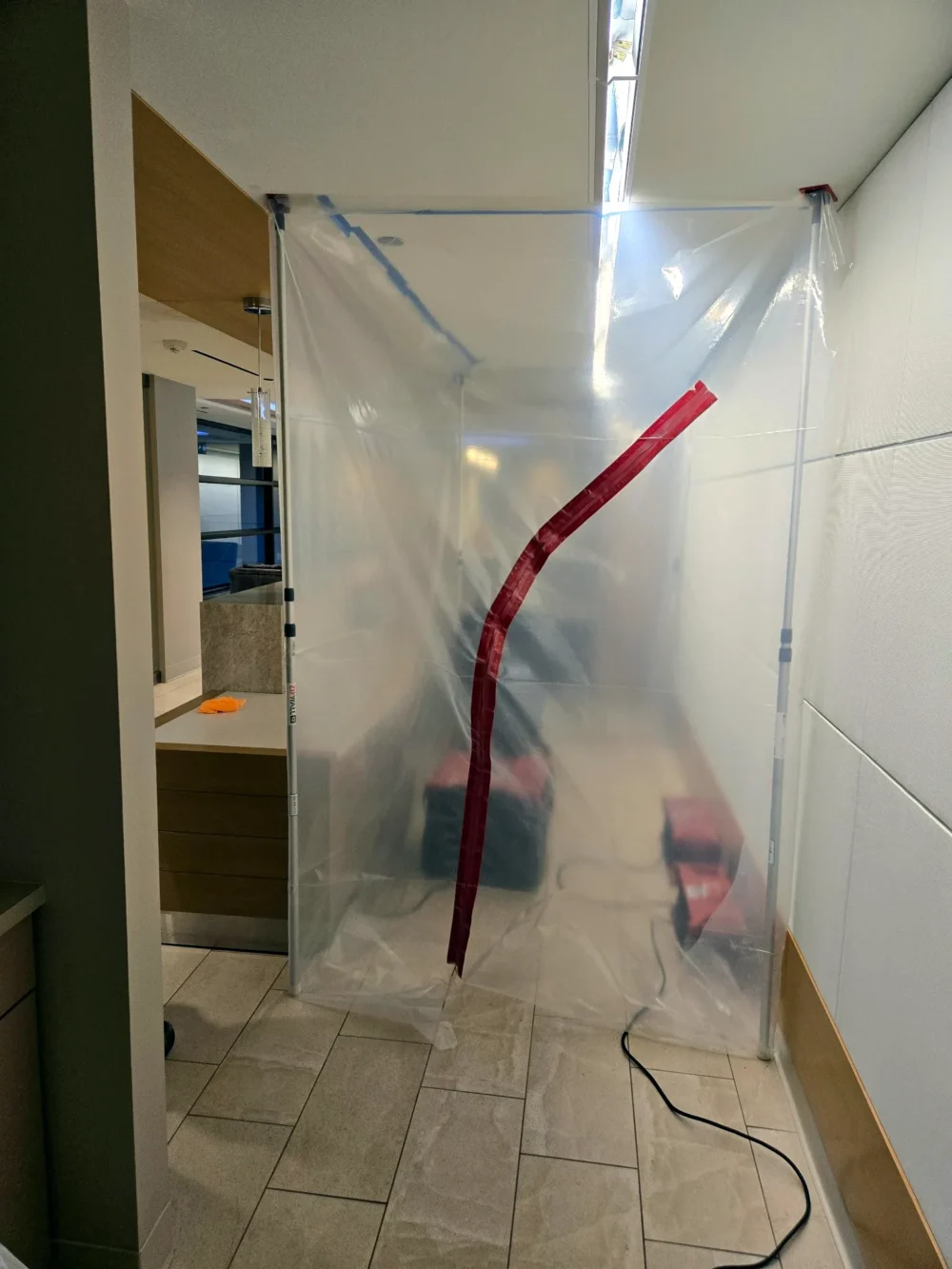
Phase 2: Containment. Before any removal begins, we seal the affected area with poly barriers and establish negative air pressure using HEPA negative-air machines. This step prevents cross-contamination — the single biggest mistake DIY mold removal makes. Without containment, disturbing a mold colony releases millions of spores into the rest of your living space.
Phase 3: Removal and HEPA Vacuuming. Contaminated porous materials — drywall, insulation, carpet, ceiling tiles — are removed and double-bagged for disposal. Non-porous surfaces are wire-brushed, HEPA-vacuumed, and treated with EPA-registered antimicrobial agents. We do not spray paint over mold or encapsulate without full removal. That approach fails re-inspection and voids the work.
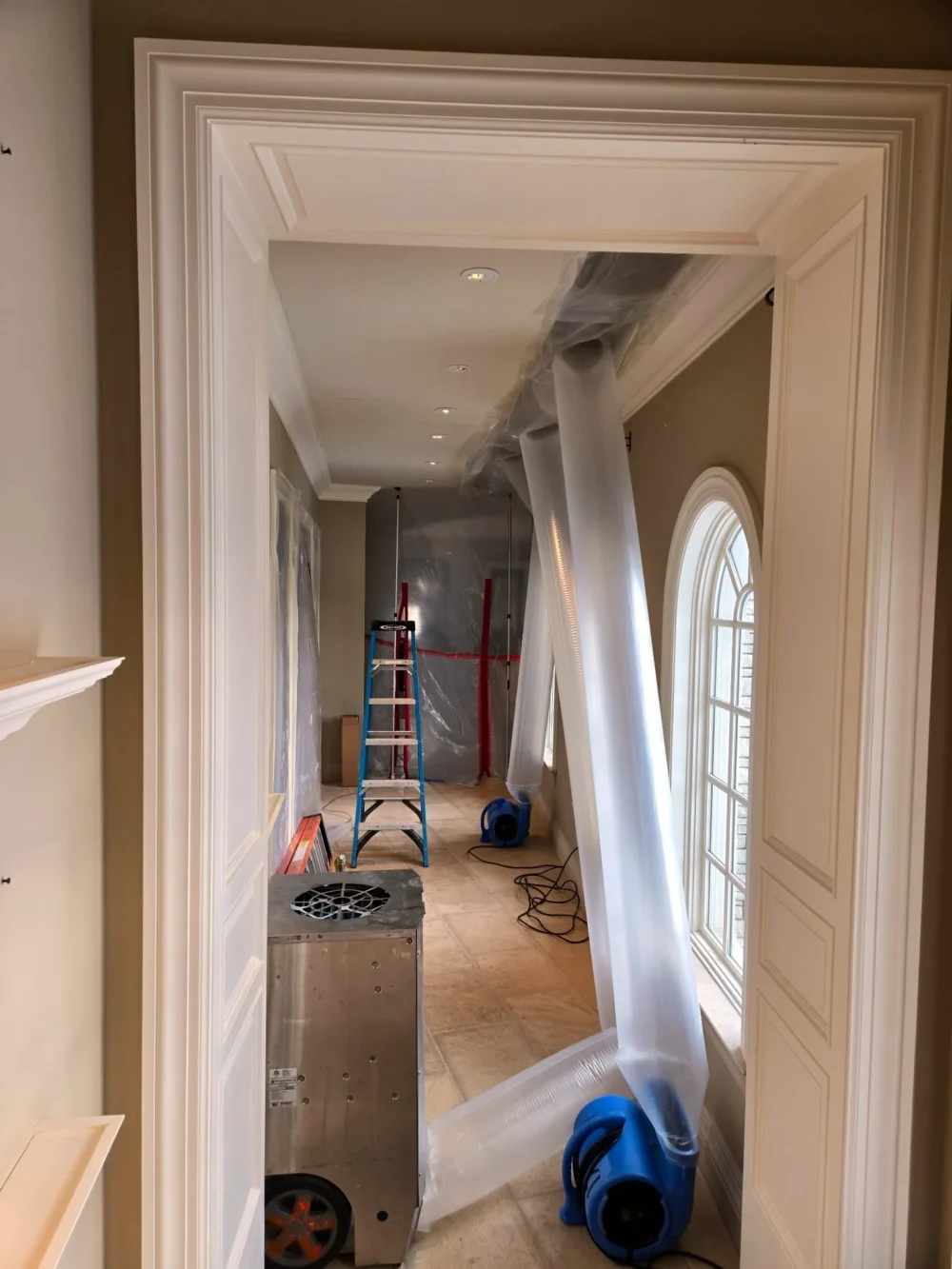
Phase 4: Structural Drying. If an underlying water source caused the mold, it must be fully dried before the space is rebuilt. We run industrial dehumidifiers — units rated at 200 pints per day — alongside structural drying mats and directional air movers. We monitor daily with calibrated moisture meters until readings normalize.
Phase 5: Clearance Testing. After remediation, an independent third-party air quality test confirms that spore counts are at or below the outdoor baseline. This clearance report is what protects you if the mold issue is ever raised in a future home sale or insurance claim. For more on the full Michigan-specific process, see our detailed Mold Removal in Michigan guide.
Different mold species require different handling. Stachybotrys chartarum — the one commonly called “black mold” — is slow-growing and requires sustained moisture, which usually means a long-standing leak. Cladosporium and Penicillium/Aspergillus species grow faster and are more common in Troy basements and crawlspaces after shorter moisture events. All require professional removal when colonies exceed 10 square feet or when growth is behind walls.
How Do Mold Remediation and Removal Services Actually Save Your Property?
Mold damage removal is not just about health — it is about stopping structural deterioration. Mold digests the organic material it grows on. Wood framing weakens. Drywall crumbles. Subfloor panels delaminate. Left for 60 to 90 days, mold damage that would have cost a few thousand dollars to remediate can require a full structural repair and rebuild.
The equipment matters as much as the process. Beyond HEPA negative-air machines and industrial dehumidifiers, our crews use thermal imaging cameras to locate moisture that has wicked into adjacent wall cavities — areas that look and feel dry to the touch but will generate a new mold colony within weeks if left unaddressed. We also perform contents cleaning and restoration for furnishings, clothing, and belongings affected by mold-contaminated air — something a consumer air purifier addresses only partially.
Preventing future growth is built into every job. We identify and document the moisture source, confirm it is eliminated or repaired, and establish target humidity benchmarks before we close the space. A properly remediated Troy home should hold indoor relative humidity between 30 and 50 percent year-round. When that number climbs above 60 percent — common in Southeast Michigan summers — mold risk rises sharply even without a water event.
What Role Does a Mold Removal Air Purifier Actually Play?
Here is the honest answer: a HEPA air purifier is a useful tool for improving indoor air quality after remediation is complete. During active remediation, the professional HEPA negative-air machines our crews deploy do the same job — but at industrial scale, with verified air-change rates, and under negative pressure to protect the rest of the structure.
A consumer-grade HEPA air purifier running in your living room will capture airborne mold spores that drift from a disturbed colony. That is meaningful for air quality, but it does nothing to the colony itself. It is the equivalent of mopping condensation off a countertop while the pipe underneath keeps dripping. The Indoor Air Quality Association is consistent on this point: source removal is the only effective long-term remediation strategy. Air filtration supports that work; it does not replace it.
UV-C air purifiers, ionizers, and ozone generators are marketed aggressively for mold. Ozone generators in particular require the space to be vacated and can damage rubber seals, electronics, and fabrics. They do not penetrate wall cavities where active colonies live. We do not recommend them as a primary mold control strategy in occupied homes.
The right air purification approach in a Troy home: run a true HEPA air purifier (MERV 13 or higher) in living areas as a maintenance measure after professional remediation is complete and clearance testing has been passed. Pair it with a whole-home dehumidifier if your basement or crawlspace runs consistently above 55 percent relative humidity.
What Happens After Mold Is Removed? Mold Damage Restoration in Troy
Mold remediation clears the problem. Restoration returns your home to livable condition. These are two separate phases, and many homeowners are surprised to learn that the remediation company they called can also handle the rebuild — no second contractor required.
After clearance testing passes, our reconstruction team handles post-remediation rebuild work: new drywall installation, insulation replacement, painting, flooring, and finish carpentry. If the moisture event that caused the mold also damaged your roof, structural sheathing, or rim joist framing, that work is coordinated through the same project file — which simplifies your insurance claim considerably.
We also address the upstream cause. If your water damage restoration was incomplete — whether from a prior contractor or from a DIY response — hidden moisture behind walls is often what we find when a homeowner calls about recurring mold months after they thought it was resolved. Incomplete drying is the leading cause of secondary mold events in Troy homes.
For a look at a real mold job from our archive, our mold remediation project documentation shows the before-and-after scope of a structural mold loss: what the affected cavity looks like before containment, what comes out, and what the rebuilt space looks like after clearance. The scale of what hides behind intact-looking walls consistently surprises homeowners who assumed the problem was minor.
How Do You Choose the Right Mold Removal Service in Troy?
Certifications are the starting point — not the finish line. The credential that matters most for mold remediation is the IICRC Mold Remediation certification. Ask any company you are considering to name the certification, identify the certifying body, and provide the certificate number. If they cannot, keep looking. Our team also holds the MII (Mold Inspection Institute) certification, which governs the inspection and testing phase separately from remediation.
For a full breakdown of what to ask before you sign anything, our post on How to Choose a Mold Remediation Specialist in Troy walks through the questions that separate real remediation from a surface-level cleanup. And if you have seen advice online about using household products to handle mold yourself, our guide on Mold Removal Using Vinegar: What It Actually Does (And When to Call a Pro) explains exactly where DIY methods end and professional remediation begins.
Local experience matters in ways that are not obvious until a crew is standing in your basement. Troy’s soil drainage patterns, the age range of construction along Maple Road and Coolidge Highway, the prevalence of balloon-frame construction in the older sections near the Troy-Birmingham border — these are details that shape how moisture moves through a structure. Our crews have worked Troy and Oakland County for 16+ years, and that familiarity accelerates every job from assessment through closeout. We are also the mold removal company Metro Detroit homeowners consistently call back — not because we are the loudest, but because the work holds up to clearance testing.
Look for a company that carries a Michigan Builders License alongside their IICRC and mold certifications. That license is what legally authorizes the reconstruction work after remediation — without it, a contractor cannot pull the permits required for structural repair in Oakland County. We hold all three, which means your project does not stall at the rebuild phase.
Protecting Your Troy Home: Honest Talk About Cost and Insurance
The hesitation we hear most often: What is this going to cost, and will my insurance actually cover it? Those are fair questions, and we will not pretend to have a universal answer — because the scope of mold damage varies enormously, and Michigan insurance policies handle mold differently depending on the cause and the carrier.
What we can tell you: if the mold resulted from a sudden and accidental water event — a burst pipe, a failed water heater, storm-driven water intrusion — most homeowners insurance policies in Michigan cover mold remediation as part of the water damage claim. If the mold resulted from slow, long-term moisture accumulation or deferred maintenance, coverage is less consistent. Our post on Mold Insurance in Michigan walks through the specifics of what carriers look for.
We document everything from the first hour on site: moisture readings, thermal images, air sample results, scope of affected materials, and photographic evidence of the loss. That documentation is exactly what an adjuster needs to process a mold remediation claim — and we coordinate directly with adjusters at Allstate, State Farm, Liberty Mutual, Auto-Owners, AAA, Travelers, and all other major carriers. We bill insurance directly. You focus on your home; we handle the paperwork.
If coverage is partial or denied, ask us about our financing options before you walk away from the remediation. Leaving active mold in place because of a coverage dispute is always the more expensive outcome — structurally and for your family’s health.
DriForce Property Restoration serves Troy and the surrounding Oakland County communities from our headquarters at 1470 Souter Blvd, Troy, MI 48083. Our IICRC-certified, MII-certified crews are available around the clock — because mold does not keep business hours, and October water intrusion from ice dam setup does not wait for Monday morning.
Water in your home? Smoke damage? Mold concerns? DriForce is on the road 24/7.
Call (888) 838-7170 now — we will be on site within 60 minutes for emergency response in Oakland, Wayne, Macomb, and St. Clair counties. We work with all major insurance carriers and bill them directly. IICRC certified. BBB A+ rated. 16+ years restoring Southeast Michigan.
