24/7 Emergency Response · Oakland County & the Blue Water Area
Hazardous Materials CleanupAcross Michigan
Sewage, biohazard, mold, asbestos and lead are not cleaning problems, they are containment problems. The work has to be isolated, the air controlled, and the material removed and disposed of under the rules that apply to it.
What you get
- Sealed containment and HEPA negative air
- EPA RRP lead-safe trained crews
- Discreet, unmarked response
Hazmat & Biohazard Cleanup · Metro Detroit & the Blue Water Area
Contaminated Property? We Handle It.Hazardous Materials Cleanup In Troy, MI, Oakland County & Beyond
Sewage, biohazard, mold, asbestos and lead are not cleaning problems. They are containment problems — the work has to be isolated, the air controlled, and the contaminated material removed and disposed of under the rules that apply to it. Certified crews, sealed containment, discreet response.
- Sealed containment and HEPA negative air on every job
- Unmarked vehicles and a discreet crew where it matters
- Compliant removal, disposal and documentation
 Trusted across Metro Detroit
Discreet Response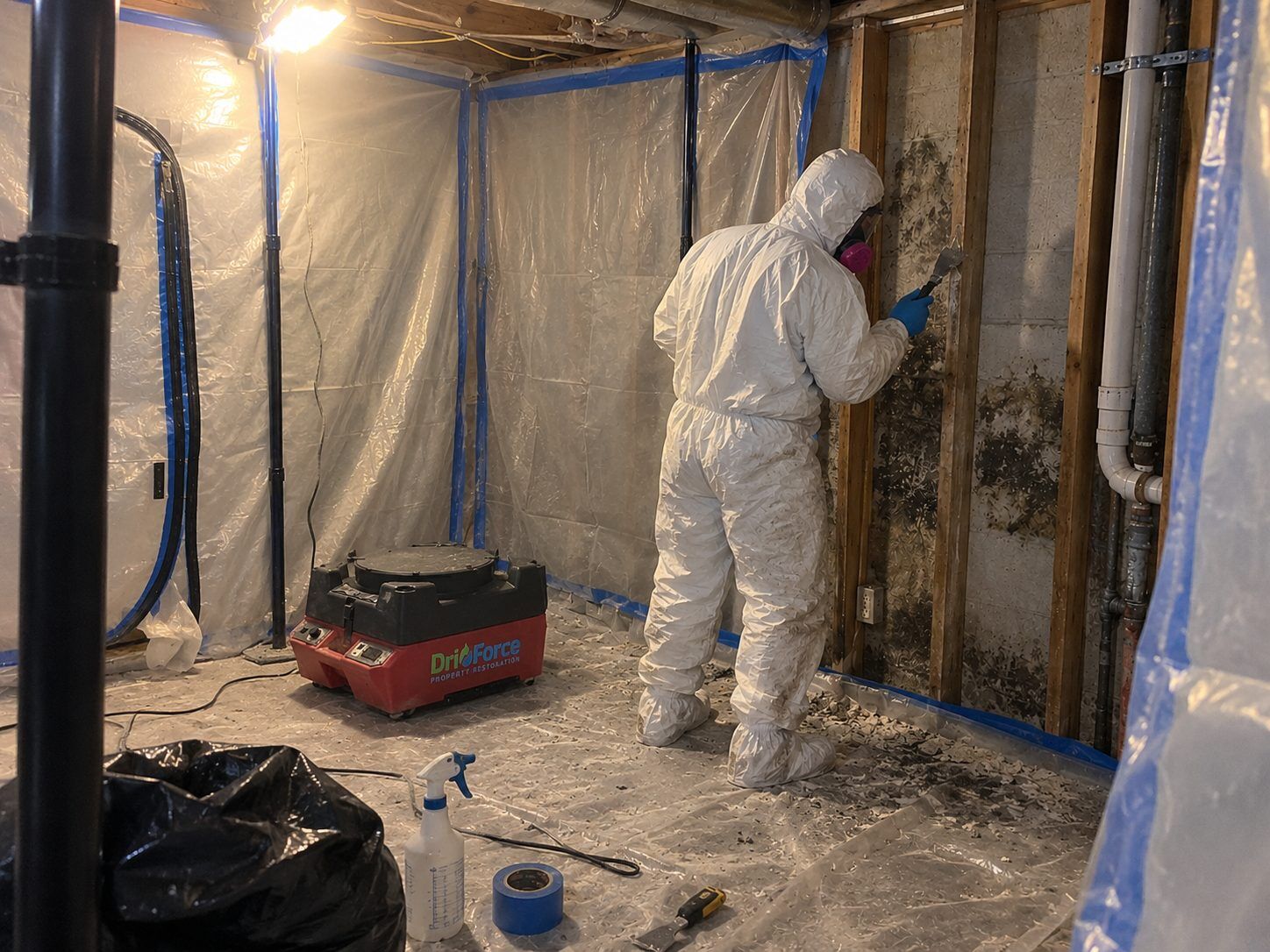
Suspected Contamination? Six Things To Do First
- 1Keep people and pets out, and close the doorThe first job is to stop the contamination spreading on shoes, paws and hands. Close off the affected room, and if a door will not close, block the route. Children and anyone immunocompromised should be out of the building, not just out of the room.
- 2Turn the HVAC offA running furnace or air conditioner will pull contaminated air out of that room and distribute it through the whole house within minutes. This single step prevents more secondary damage than anything else on this list.
- 3Do not clean it yourself, and do not use bleachWiping a contaminated surface moves material around and aerosolizes it. Bleach does not make porous materials safe, it does not address what has soaked in, and on mold it mostly adds water. The visible mess is not the hazard.
- 4Do not disturb anything that might contain asbestosIn a building put up before about 1980, old pipe wrap, floor tile, sheet flooring backing and textured ceilings can contain asbestos. Undisturbed it is generally not a hazard. Broken, sanded or swept up, it is. Leave it and tell us it is there.
- 5Photograph it from the doorwayGet what you can without entering. The claim is decided on what can be documented, and once containment goes up the scene changes. If you cannot photograph it safely, do not — we will document it on arrival.
- 6Call us — a person answersTell us what you are looking at and we will tell you honestly whether it needs a certified crew or whether you can handle it. Not everything does. Where a response should be discreet, say so on the call and it will be.
Tell Us What Happened
A real person answers 24/7, and these calls are handled quietly. You do not need the right vocabulary — describe what you are seeing or smelling and we will work out what it is. Prefer to type it? Send the details and we respond the same day.
This Is A Containment Job, Not A Cleaning Job
The difference is what happens to the air. Cleaning a contaminated room without containment moves the hazard rather than removing it — onto shoes, into the HVAC, into rooms nobody has been in. That is why the first thing our crews build is not a cleaning station but a barrier.
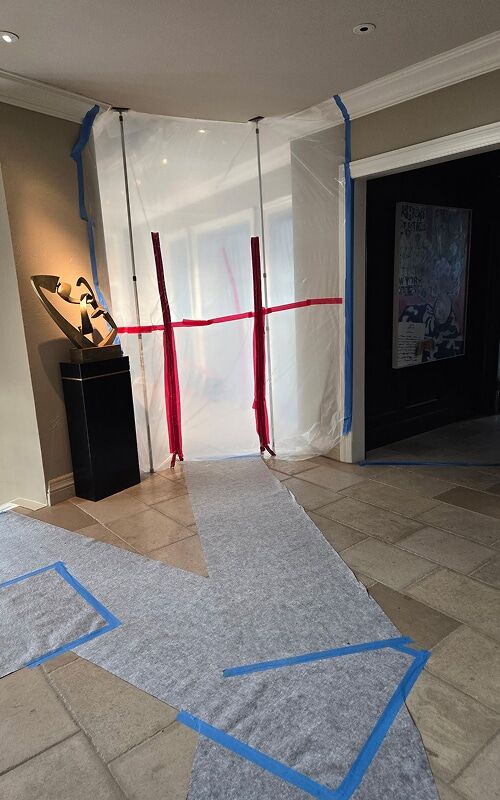
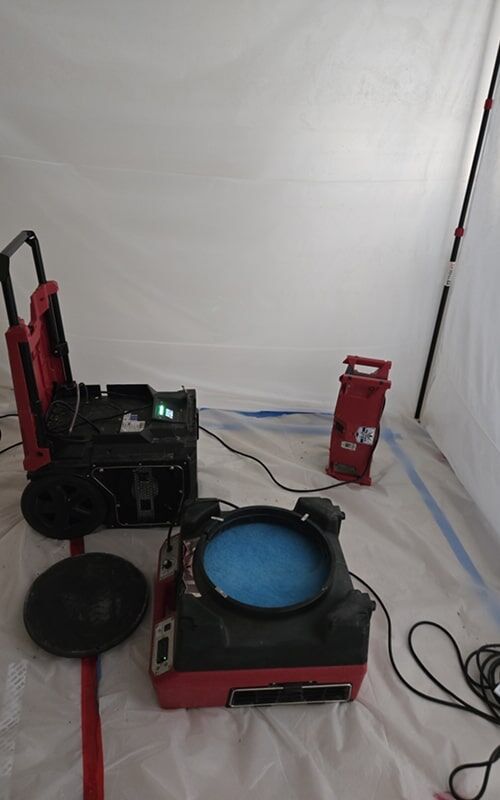
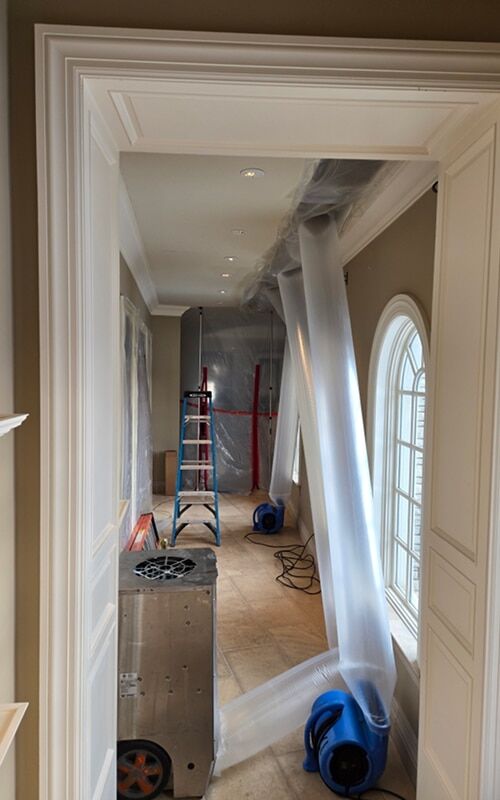
Sealed poly containment, a zip-door entry, and negative air pressure maintained with HEPA filtration, so the air inside the work area can only move one way: in, through a filter, and out. Everything that leaves goes out bagged, through the entry, under the same control.
The other half is knowing what has to go and what can stay. Porous material that has absorbed contamination generally cannot be made safe in place — drywall, insulation, carpet, pad and soft contents come out. Hard, non-porous surfaces can usually be cleaned and disinfected. Getting that line right is the difference between a scope that holds up and one that gets re-done.
How A Hazmat Job Actually Runs
The order is the safety measure. Every step exists to keep the hazard inside the work area and off everything else you own.
1Assess before anything is touched
We identify what the material actually is, how far it has traveled, and what it has soaked into — because the answer changes the protocol entirely. Sewage, blood, mold and asbestos are four different jobs with four different rule sets.
2Build containment and take control of the air
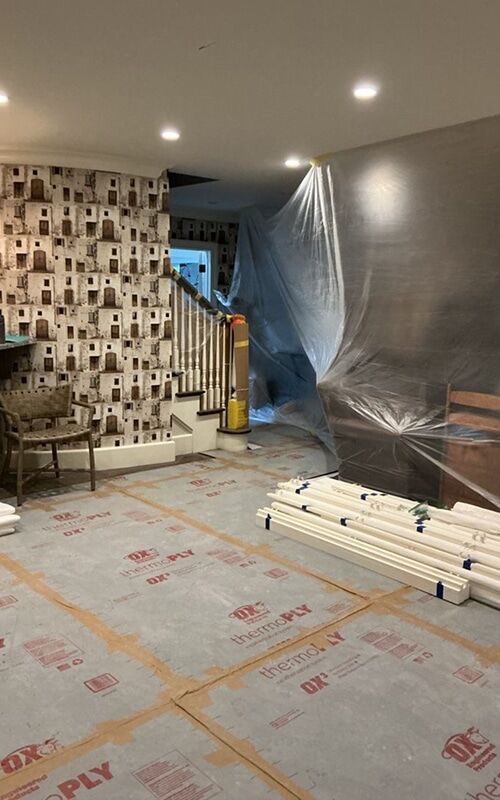
Sealed poly barriers, a zip-door entry, floor protection on the route out, and negative air pressure held with HEPA filtration so contaminated air cannot migrate into the rest of the building.
3Remove what cannot be made safe
Porous material that has absorbed contamination comes out and is bagged inside containment. Nothing is carried through clean space unsealed, and nothing that should be disposed of under regulation goes out with the household waste.
4Clean, disinfect and deodorize what stays
Hard surfaces and structure get cleaned and treated with the appropriate disinfectant for the contaminant — not a general-purpose cleaner — followed by odor treatment that removes the source rather than covering it.
5Dry the structure and verify
Where water was involved, the structure is dried with logged daily readings. Where verification is warranted we use independent third-party testing, because a result you can show a carrier or a future buyer has to come from someone with nothing to gain from it.
6Rebuild what came out
Drywall, insulation, flooring, paint and trim, by the same licensed Michigan builder and under the same claim, so the space is finished rather than just decontaminated.
Hazmat Claims: What Usually Pays, And What Usually Does Not
The cause decides the coverage, far more than the contaminant does. A sudden failure that contaminates a building is usually covered. A condition that developed over time usually is not, and knowing which one you have before you call your carrier is worth a great deal.
DIFS also warns homeowners to be careful with the word “flood” when reporting a loss — it has a specialized meaning that points at an exclusion. A sewer backup is not a flood. Describe what actually happened and ask what coverage applies.Michigan DIFS consumer guidance. DIFS Consumer Services: 877-999-6442.
Straight Answers About Cost and Coverage
On a covered claim your deductible is usually all you pay out of pocket. We build the scope, document the loss the way a carrier needs to see it, and settle the covered work directly with them.
What actually drives the number is how much porous material has to be removed rather than cleaned, how large an area has to be held under containment, and how long negative air has to run. Square footage matters less than absorbency: a small area of saturated carpet, pad and drywall is a bigger job than a large area of tile.
We will also tell you when you do not need us. Some of what people call in about is genuinely within reach of a homeowner with the right precautions, and we would rather say so than sell a containment nobody needed. Where the work is real, you get a documented, line-item scope in writing before it begins, and the inspection and the scope come with no obligation.
For adjusters, agents & property managers: contamination losses documented the way they need to be defended — contaminant identification, containment and air-control records, time-stamped photo sets, disposal documentation and line-item scopes in carrier-ready format. Call (888) 838-7170 or use our contact page and reference your claim number.
What Our Customers Say
4.9192 Google Reviews
“We woke up on a Monday morning to a totally flooded basement, malfunctioned hot water tank — not only did he calm me down, he had a team onsite within the hour.”
Kathy · Google Review
“The only restoration company that picked up the phone at around 11:30pm when we found our basement flooded. Casey and Harold did great job. Impressed!”
Agnes · Google Review
“Dri-Force did an outstanding job restoring my basement post-flood. Excellent communication. Excellent planning. Quick. Clean. Responsive to everything we asked.”
Jack · Google Review
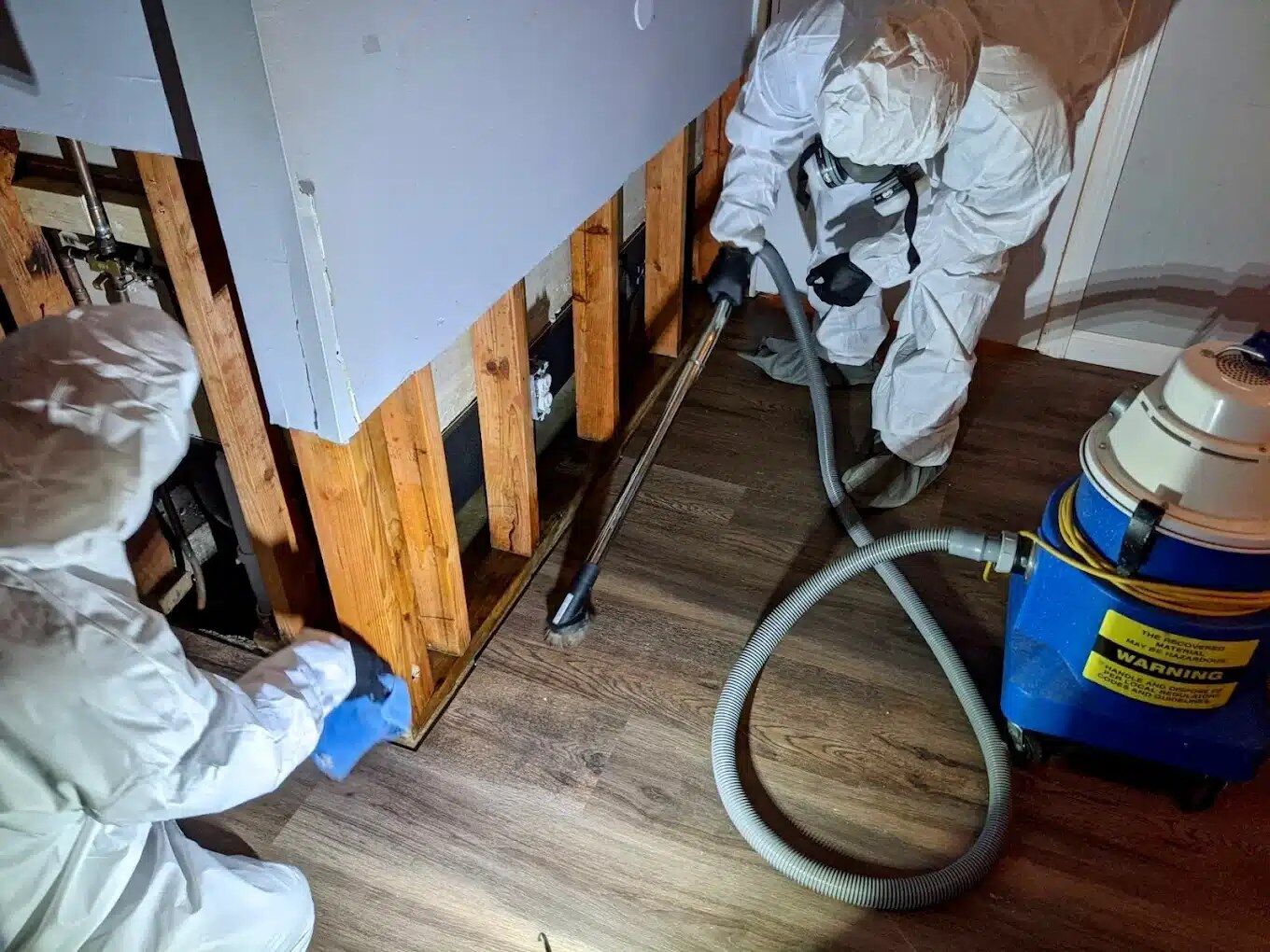
What Containment Actually Looks Like
Sealed barriers, controlled air and full PPE on real DriForce jobs across Metro Detroit and the Blue Water Area.
Four Contaminants, Four Different Protocols
None of these is a job for a mop and bleach, and none of them is the same job as the others. What follows is what each one actually is, and what it needs.
- Sewage and black waterA sewer backup, or water that has contacted sewage, is Category 3 under the IICRC’s S500 standard — grossly contaminated, carrying bacteria and other pathogens. Porous material it has touched comes out; it is not dried in place. Extraction, removal, disinfection and structural drying, under containment.
- Biohazard and traumaBlood and other potentially infectious material from an accident, an unattended death or a violent incident. Handled under bloodborne-pathogen precautions with full PPE, discreetly and without a marked truck outside. Contaminated porous material is removed and disposed of under regulation, and the space is restored rather than left opened up.
- MoldThe hazard homeowners meet most often, and it almost always follows water. Containment first, removal at the source, HEPA air filtration throughout, and then — the part that is skipped most often — fixing the moisture that fed it. Without that last step it returns.
- Asbestos and leadCommon in buildings put up before about 1980: pipe wrap, floor tile, sheet flooring backing, textured ceilings, and lead paint in anything pre-1978. Undisturbed, generally not a hazard. Disturbed by demolition, sanding or sweeping, it becomes one. We work to EPA RRP lead-safe practices and coordinate accredited abatement where the material requires it.
- Hoarding and heavily soiled propertiesUsually several of the above at once, plus a structure nobody has been able to see for years. These are handled slowly and without judgement, sorting and documenting as we go, with the family’s priorities leading rather than ours.
- Unattended death and decompositionAmong the most difficult calls we take, and the ones where discretion matters most. Decomposition penetrates deeply into porous material and subfloor, which is why surface cleaning never resolves the odor. Removal has to follow the contamination as far as it went.
Everything Else Worth Knowing Before You Call Anyone
Sewage: Why Category 3 Water Is Not Dried In Place
The restoration industry classifies water by how contaminated it is, under the IICRC’s S500 standard. Category 1 is clean water from a supply line. Category 2 carries significant contamination — a washing machine discharge, for instance. Category 3 is grossly contaminated, and sewage is the clearest example.
The practical consequence is that Category 3 changes what can be saved. Porous material that has absorbed it — carpet, pad, drywall, insulation, particleboard — is removed rather than dried, because drying a contaminated material leaves a dry contaminated material. Hard, non-porous surfaces can usually be cleaned and disinfected and stay.
This is the point where homeowners and contractors most often disagree, and it is worth understanding rather than taking on trust. If someone proposes to dry sewage-affected carpet and leave it down, ask them to put that in writing.
Asbestos And Lead: Age Is The First Question
If the building went up before roughly 1980, assume asbestos may be present until it is ruled out — commonly in pipe and duct wrap, 9×9 floor tile and the black mastic under it, sheet flooring backing, textured ceiling finishes and some siding and roofing products. If it went up before 1978, assume lead paint.
The critical point about both is that intact, undisturbed material is generally not the hazard. The hazard is created by disturbing it: demolition, sanding, scraping, dry sweeping. A homeowner starting a small demolition project is the most common way a stable material becomes an airborne one.
We work to EPA RRP lead-safe practices in pre-1978 housing, and where a material requires accredited asbestos abatement we coordinate it rather than improvise around it. If you are planning work in an older building, testing first is far cheaper than testing after.
Trauma And Unattended Death: What To Expect From Us
These are the calls we take most carefully, and there are a few things worth knowing in advance so the day is not also full of surprises.
We arrive discreetly. Where it matters, that means unmarked vehicles and a crew who will not discuss the job on your driveway. Neighbors do not need to know what happened in your home.
Removal follows the contamination, not the visible area. Biological material penetrates into flooring, subfloor and framing, which is why the work often goes further than expected, and why surface cleaning never resolves the odor. We will show you what we find and explain why it has to come out before it does.
You do not have to be there. Many families would rather not be, and that is entirely reasonable. We can work with an insurer, an attorney, a property manager or another family member, and we will document everything so nobody has to take our word for what was done.
Hoarding Situations, Handled Without Judgement
Hoarding cleanups are rarely just cleanups. They usually involve several hazards at once — biological contamination, pest activity, mold behind material that has been against a wall for years, and sometimes structural or electrical problems nobody could see.
They are also, always, about a person. The work goes at the pace the family sets, sorting rather than bulldozing, with anything of apparent value or significance set aside for a decision rather than disposed of. Documents, photographs and personal effects get looked for deliberately.
Where a property has reached the point of a municipal order or a condemnation notice, tell us that on the first call. The timeline changes what gets prioritized, and we have worked to those deadlines before.
Hazardous Materials Cleanup, Answered
Related Services & Nearby Communities
Contamination rarely arrives on its own. The same certified crews handle the water that caused it and the rebuild that follows — in every community we serve, day or night.
Most contamination we are called to started as water. We also handle water damage of every cause, mold remediation, contents restoration for belongings worth saving, and rebuild and property repairs. Crews dispatch 24/7 from our Troy office for Oakland, Macomb and Wayne counties and our Port Huron office for St. Clair County and the Blue Water Area.
Tell Us What You Are Looking At
A person will answer, and the call will be handled quietly. You do not need to know what the material is or what to call it — describe what you can see or smell and we will work out what it needs. If the answer is that you do not need us, we will tell you that too.