The honest answer most contractors will not give you: usually no — unless the mold resulted from a sudden, covered water event, and even then your policy probably caps the payout. DriForce Property Restoration documents mold losses for Michigan adjusters every month. Here is how coverage actually works, so you know your position before you file — and how to protect the claim you do have.
The Rule Behind Every Mold Claim: Sudden and Accidental vs. Gradual
Almost every mold coverage decision comes down to one question the adjuster is trained to ask: was the water event that caused the mold sudden and accidental, or was it gradual? Standard Michigan homeowners policies (the widely used HO-3 form) cover sudden, accidental water discharge and the damage that follows from it. They exclude losses that build up slowly over weeks or months, and they exclude damage tied to a lack of maintenance. Mold is rarely named as its own covered peril — instead it is treated as a consequence, and it is only covered when the water that fed it was itself covered. Understand that single distinction and most of the confusion around mold claims disappears.
When IS Mold Covered by Homeowners Insurance?
Mold is covered when it is the direct result of a covered peril — a burst pipe, a failed water heater or washing-machine hose, an overflowing appliance, a storm that drives water into the structure, or the water used by firefighters to put out a fire. The chain matters: covered water event first, then mold. This is the “ensuing loss” or “resulting damage” principle — the mold rides on the underlying water claim. If we remediate mold that grew after a pipe burst, our documentation ties every affected surface back to that originating event, on the date it happened, so the adjuster can approve it as part of one connected loss rather than an isolated mold problem.
Typical covered scenarios we see across Oakland and Macomb counties include a supply line that lets go behind a finished basement wall, a water heater that fails while the family is away, and roof or window water intrusion after a windstorm. In each case the speed of the response is what preserves both the property and the claim.
When Is Mold Excluded?
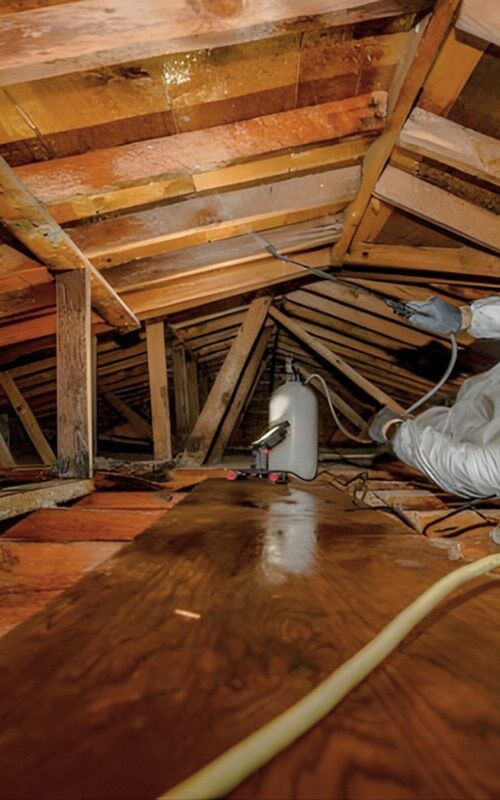
Gradual problems are the classic denials: long-term seepage, repeated small leaks, chronic high humidity, poor ventilation, condensation, and neglected maintenance. Insurers treat these as preventable, and claims built on them get denied under the maintenance and “continuous or repeated seepage” exclusions. Flooding is its own category — rising surface water is excluded from a standard homeowners policy entirely and is only covered by a separate flood policy (NFIP or private), so mold that follows a true flood usually is not covered unless you carry that flood coverage. This is also why timing matters so much: mold from last month’s covered pipe burst is a claim; mold from a leak you have known about since spring almost never is, because the policy expects you to have addressed a problem you were aware of.
What Are Typical Mold Coverage Caps in Michigan?
Even when mold is covered, most Michigan policies cap the payout — commonly in the $1,000 to $10,000 range — unless you carry a mold endorsement (often listed as a “fungi, wet or dry rot” limit) that raises it. Check your declarations page for that specific line item; it is the number that decides your exposure long before a claim happens. On larger losses, the cap makes early professional drying the difference between a covered cleanup and an out-of-pocket one. The math is simple: stop the mold before it spreads and the cap never gets tested. Every hour of delay after a water loss moves more of the cost from “covered water mitigation” into “mold remediation” — the category most likely to be capped.
Michigan-Specific Considerations
Michigan does not have a law forcing homeowners insurers to cover mold, so coverage lives entirely in your individual policy language and endorsements — two neighbors with different carriers can get very different answers to the same burst pipe. Our climate also works against homeowners: humid summers and long, cold winters drive condensation inside walls, basements, and around windows, and that slow, humidity-driven growth is exactly the kind insurers exclude. Sewer and drain backups — common in older Metro Detroit neighborhoods during heavy rain — are also excluded unless you carry a specific sewer-backup endorsement, which is one of the most valuable and least expensive add-ons a Michigan homeowner can hold. If a backup floods a finished basement and mold follows, that endorsement is often what stands between a covered loss and a five-figure bill.
How to Build a Mold Claim That Gets Paid
The claim is won or lost in the first 48 hours. Document the water event immediately — photograph the source, the standing water, and every affected room before anything is moved, and note the date and time. Stop the source if you safely can. Get professional moisture readings on day one so there is an objective record of how far the water traveled, and resist the urge to rip out or bleach visible mold before it has been documented, because that erases the evidence your claim depends on. Then use a remediation contractor who is fluent in insurance scoping and works to the IICRC S520 mold remediation standard — the written scope, containment plan, and moisture logs are what an adjuster approves against. Choosing that contractor is its own decision; our guide to choosing a mold removal company covers the vetting questions, and the actual mold remediation process is broken down step by step on our service page. Crews serving West Bloomfield and all of Oakland County respond within 60 minutes.

The Denial You Can Appeal — and the One You Cannot
Denials citing “gradual damage” are worth a second look when the underlying event was genuinely sudden: a hidden supply-line break that only revealed itself through mold is not the same as a roof that leaked for three winters, and adjuster files get reopened on exactly that distinction. Plumbing records, moisture readings, and the remediation contractor’s source documentation are what turn that appeal from an argument into evidence. A denial on a maintenance-neglect exclusion with photos of long-term staining behind it, on the other hand, rarely moves — which is one more reason the moment you find mold, documentation beats demolition.
What to Do the Moment You Find Mold
If you have just found mold, take five steps before you touch anything: (1) stop the water source if it is safe to do so; (2) photograph everything, including the suspected source; (3) do not disturb, bleach, or start tearing out the mold, which spreads spores and destroys documentation; (4) call a certified remediation company for an assessment; and (5) notify your insurance carrier and open a claim. Doing these in order protects both your family’s air quality and your coverage. One phone call to DriForce Property Restoration starts steps one through four at once.
Frequently Asked Questions
Schedule Mold Remediation in Metro Detroit with DriForce Property Restoration
Call DriForce Property Restoration at (888) 838-7170 or request service online — crews dispatch 24/7 with a 60-minute response commitment across Metro Detroit.