The Building Does NotGet To Close.
Restoration engineered to run inside a working facility — sealed containment, negative pressure exhausted outside, and a sequence built around your shutdown window rather than ours.
Call 888-838-7170Contact usOccupiedbuildingsNights& weekendsIICRCS500 / S520One licensethrough rebuild
Every decision on your site is downstream of one fact.
You are not buying drying equipment. You are buying a work method that can operate in a building full of people without becoming their problem.
The building has to keep operating. Everything else is negotiable; that is not.
Restoration inside an occupied facility is a different discipline from restoration in an empty one. The technical work is the same. The constraints are not: people are still walking the corridors, air still moves between zones, and a route you block at 9am is a life-safety problem by 9.05.
So the plan starts with what cannot be interrupted — egress, critical systems, the areas that have to stay open — and the restoration sequence is built to fit inside it. Not the other way round.
The containment plan, drawn.
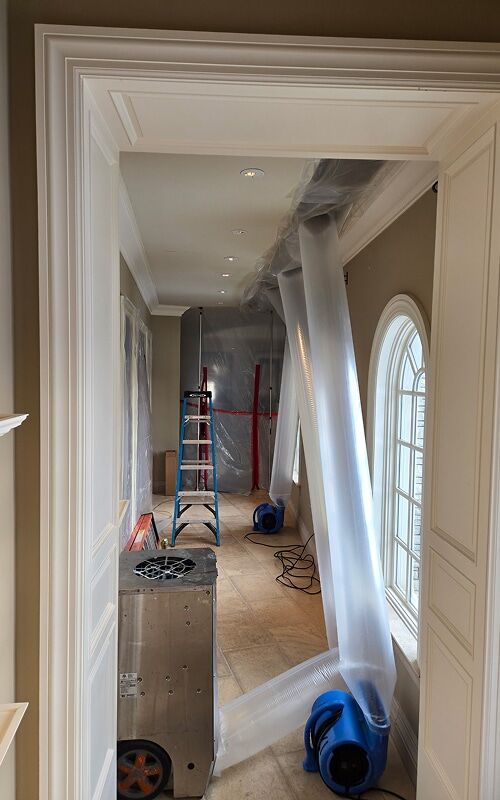
This is the arrangement we build on a typical occupied-building job. It is worth knowing what it looks like, because it is the part that determines whether your tenants notice the work at all.
- Barrier and zippered entryThe work zone is physically sealed from occupied space, with a single controlled entry point rather than an open edge.
- Negative pressure, verifiedAir moves into the containment and never out of it, so nothing crosses into areas people are using.
- Exhausted to the exteriorFiltered air is ducted outside rather than recirculated through the building’s own return.
- Protected egressRoutes stay open, lit and walkable. Where a path must move, it moves before the work starts and it is communicated first.
- Post-remediation verificationOn microbial work, the IICRC S520 standard’s verification step before containment comes down — not a visual glance.
Built around your shutdown window.
Most facilities have a window when disruptive work is possible. The job either fits inside it or it becomes your problem.
- Before mobilizationConstraints capturedOperating hours, areas that cannot be interrupted, permit requirements, vendor onboarding, and who on your team holds which isolation.
- First responseStabilise without disruptingSource control, containment and protection go in first so the loss stops growing while the wider plan is agreed.
- Scheduled workInside the window you setNight, weekend or planned-shutdown work where daytime work would interrupt operations. The sequence is staged to fit the window, not extended past it.
- CoordinationWith your trades, in writingHandoffs between our crews and your maintenance team are agreed in advance and documented, including any life-safety system impairment.
- ReconstructionSame contract, same licenseRebuilt to current code with permits and inspections managed, under Michigan Builder License #2102202262.
Standards, license and warranty.
Work inside an occupied building is governed by published standards. These are the ones we work to, and the credentials you can check independently.
- IICRC Certified FirmWater restoration, applied structural drying, microbial remediation, fire and smoke, odor control and trauma certifications held on staff. Listed publicly in the IICRC Global Locator under our legal entity, Absolute Water Removal, LLC dba DriForce Property Restoration — verify it before you call, not after.
- Michigan Builder License #2102202262Mitigation and reconstruction run on one license, under one contract. You are not handed to a separate general contractor when the drying finishes.
- One-year workmanship warrantyOn reconstruction we perform, separate from any manufacturer warranty on materials. Ask any other restorer you are considering to put theirs in writing.
- Documentation on requestW-9, certificate of insurance and current certifications supplied before work starts, so vendor onboarding is not the thing holding up mitigation.
What facility directors ask us first.
Can you work without shutting the building down?
That is the normal case, not the exception. Work areas are sealed under negative pressure with a zippered entry, air is exhausted outside rather than into occupied space, and egress routes stay open and protected. Full shutdowns happen when the hazard genuinely requires it, and we will say so plainly rather than discover it halfway through.
Will you work nights, weekends or inside a planned shutdown window?
Yes. Tell us the window you have and we build the sequence around it. For facilities with fixed operating hours this is usually the deciding factor in how the job is staged.
How do you coordinate with our own maintenance staff and trades?
Directly. Your team holds the building knowledge, we hold the restoration scope. We agree in advance who isolates what, who holds which permit, and where the handoffs are, then document it so nobody is guessing at 2am.
What about our life-safety systems during the work?
Any interaction with detection, suppression or alarm systems is planned with you and your provider before work starts, not improvised on site. Impairments get documented.
Are you licensed to do the reconstruction as well?
Yes. Michigan Builder License #2102202262, so the rebuild runs on the same contract as the mitigation, to current code, with permits and inspections managed.
How is mold handled in an occupied facility?
Under the IICRC S520 standard for professional mold remediation: containment, negative pressure, controlled removal and post-remediation verification. The occupied side of the building stays separated from the work throughout.
Can you provide documentation for our vendor onboarding?
W-9, certificate of insurance and current certifications before work starts. Vendor paperwork should never be the reason mitigation is delayed.
Do you cover multi-building or campus events?
Yes — see large loss restoration. A campus event is scoped as one incident with one command structure rather than several jobs competing for the same crews.
Tell us the building and the window you have.
Operating hours, shutdown constraints and which areas cannot be interrupted. That is what determines how the job gets staged.
Send the details
A person answers 24/7. Prefer to type it? Send what happened and we respond the same day.

DriForce handles water damage, fire and smoke damage, mold remediation, storm damage, hazardous materials cleanup, frozen and burst pipes, contents and document recovery and reconstruction — the full scope under one licensed builder. For multi-building or industrial events see large loss restoration, and for the complete commercial picture see commercial restoration. Crews dispatch 24/7 from our Troy office across Oakland, Macomb and Wayne counties and our Port Huron office across St. Clair County and the Blue Water Area.