

24/7 Emergency Response · Oakland County & the Blue Water Area
Emergency Tree RemovalAcross Michigan
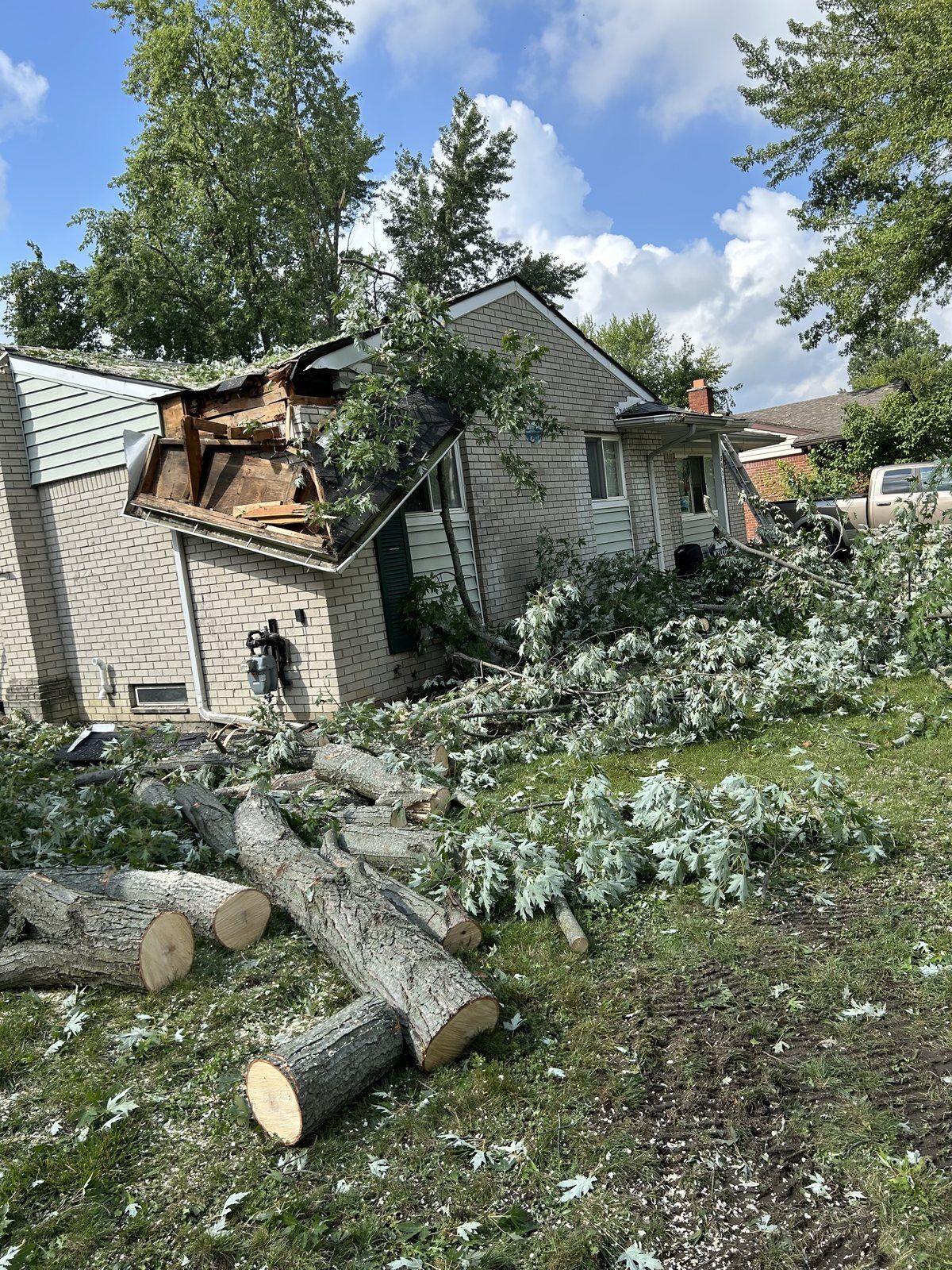
A tree through your roof is two emergencies, not one — the tree, and everything it broke. We tarp the opening first, take the tree off in sections, then dry and rebuild what it damaged. One call instead of three.
What you get
- 24/7 response, a live person answers
- Tarping and board-up on the first visit
- We repair the damage, not just remove the tree
24/7 Emergency Tree Removal · Metro Detroit & the Blue Water Area
Tree On Your House? We’re On Our Way.Emergency Tree Removal In Troy, MI, Oakland County & Beyond
A tree through your roof is two emergencies, not one — the tree, and everything it broke. We tarp the opening first, take the tree off in sections, then dry and rebuild what it damaged. One call instead of a tree service, then a roofer, then a builder.
- Tarped and secured before the tree comes off
- We repair the roof, structure and interior too
- One licensed Michigan builder, one insurance claim
 Trusted across Metro Detroit
60-Min Response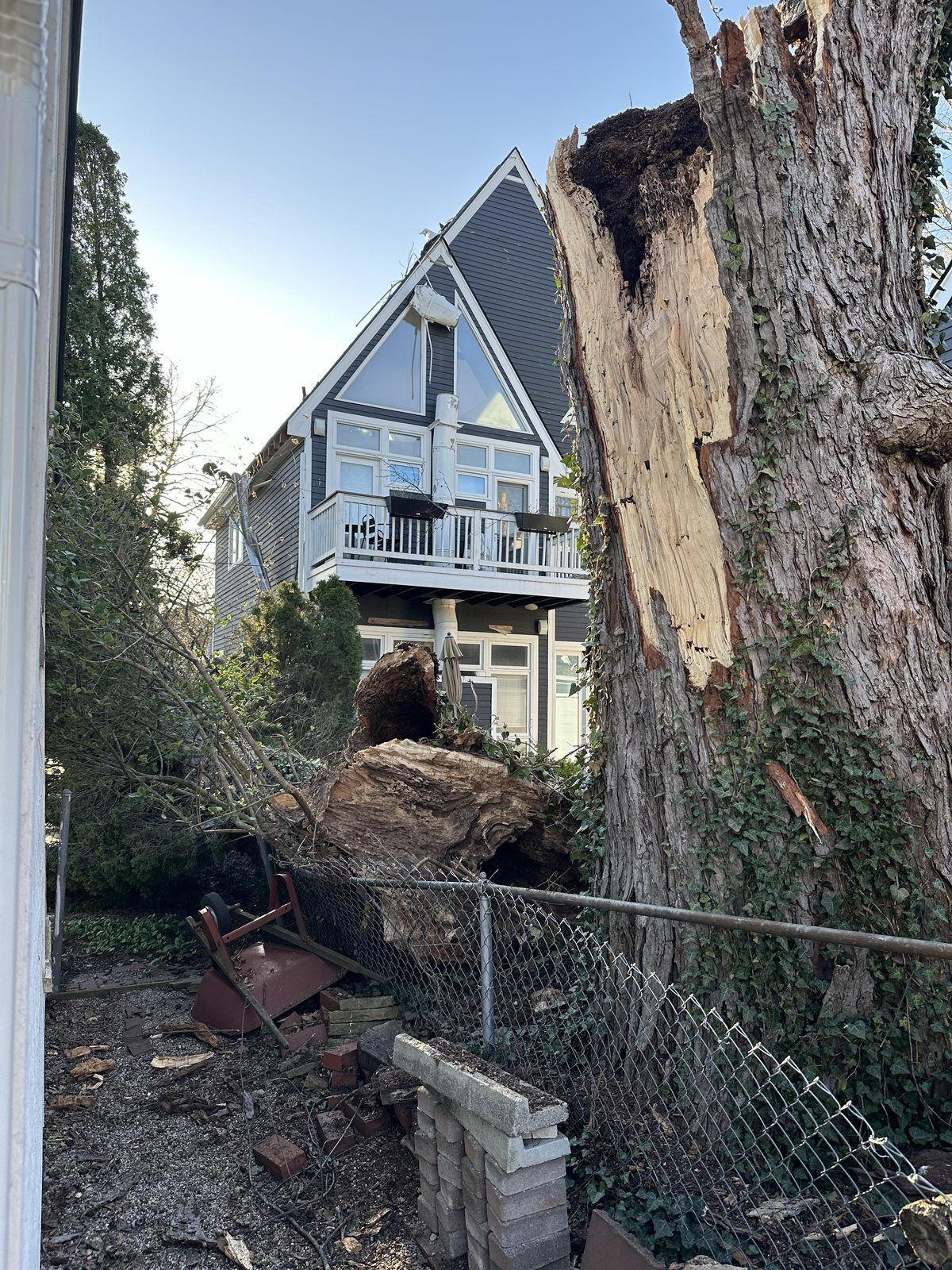
Tree Down On Your House? Do These Six Things First
- 1Get everyone out from under itA tree resting on a structure has not finished moving. Loading shifts as wind changes and as the roof yields under it. Clear the rooms beneath and around the impact and stay out of them until a crew has stabilized the load.
- 2Do not go on the roof, and do not pull on the treeThe structure is already compromised and the tree’s weight distribution is not what it looks like. Cutting or pulling a limb under tension is how a branch releases suddenly. This is the part that needs rigging, not a chainsaw.
- 3Treat every downed line as liveIf a line is down, on the tree, or in contact with anything, stay at least 30 feet clear and call DTE or your utility before anyone approaches. No tree work of any kind happens until the utility confirms the line is dead.
- 4Cut power to any room taking waterOnly if the panel is dry and you can reach it without standing in water. If you cannot, leave it and tell us when you call.
- 5Photograph it before anything movesEvery angle of the tree, the opening it made, the rooms below, and anything the water reached. The claim is settled on what the adjuster can still see, and the tree has to come off before they get here.
- 6Call us — a person answersA crew leaves Troy or Port Huron while you are on the phone, with tarps, board-up material and extraction equipment already loaded. Securing the opening comes before the removal, because rain does more damage overnight than the tree did on impact.
Tell Us What Happened
A real person answers 24/7. If a tree is on a structure or blocking access, say so first — those go to the front of the queue. Prefer to type it? Send the details and we respond the same day, usually within the hour.
A Tree Service Cuts The Tree And Leaves. That Is Half The Job.
The tree is the visible emergency. The opening it made is the expensive one. A crew with a chainsaw and a chipper can get the trunk off your roof. What they cannot do is tarp the hole, extract the water that came through it, dry the structure, or rebuild the rafters, sheathing, ceiling and insulation the impact destroyed.
So the homeowner ends up managing three vendors on three schedules, with three invoices, while the roof stays open. Meanwhile the carrier is being asked to settle one loss from three disconnected scopes — which is exactly the situation where coverage arguments start.
We do the whole sequence in one file: stabilize, tarp, remove in sections, extract and dry, then rebuild to pre-loss condition. One licensed Michigan builder is accountable for all of it, and the documentation runs from the first hour instead of being reconstructed after the fact.
What A Tree Emergency Actually Involves
A tree on a structure is a sequence, not a single job. Each step protects the one after it, which is why the order is not negotiable.
1Make it safe before anything else
We stabilize the scene, keep everyone clear of compromised structure, and assess how the tree is actually loaded — which is rarely how it looks from the ground. Nothing gets cut until we know which way the weight will go.
2Tarp and board up the opening
Heavy-duty tarps over the roof opening and board-up on any breached wall or window, before the removal starts. This is the step that decides whether the water damage stays in one room.
3Section the tree off the structure
Controlled, rigged removal in pieces rather than a single cut. The structure underneath is already weakened and cannot take the shock load of a whole trunk releasing at once.
4Clear the debris, grind the stump
Branches, limbs and storm debris hauled away, and the stump ground out if you want the yard finished rather than just cleared.
5Extract and dry what the water reached
Anything that came through the opening gets extracted and dried with logged daily readings — the attic, the insulation, the ceiling cavity and the rooms below. Saturated insulation does not dry in place; it comes out.
6Rebuild to pre-loss condition
Rafters, sheathing, roofing, siding, drywall, insulation, paint and trim — by the same licensed builder, under the same claim, with one point of contact.
Tree Damage Claims: What Is Usually Covered, And What Catches People Out
A tree that hits a covered structure is one of the more straightforward claims. A tree that hits nothing is a different conversation entirely, and that is where most of the surprises live.
DIFS also warns homeowners to be careful with the word “flood” when reporting a loss — it has a specialized meaning that points at an exclusion. Rain that entered through a roof a tree opened is water damage. Say it that way and ask what coverage applies.Michigan DIFS consumer guidance. DIFS Consumer Services: 877-999-6442.
Straight Answers About Cost and Coverage
On a covered claim your deductible is usually all you pay out of pocket. A tree striking a covered structure in a storm is a sudden, accidental loss, and we settle the covered work directly with your carrier.
What actually drives the number is how long the roof stayed open, how far the water traveled before anyone found it, and how much of the structure has to be rebuilt rather than patched. A tree removed and tarped the same morning and one left through a weekend of rain are not the same job, whatever the tree weighed.
A hazard tree removed before it falls is not an insurance event at all — it is planned work, quoted in writing, on your schedule. If you have a tree you are unsure about, that is a much better phone call than the one at 2am. We put a documented, line-item scope in writing before any work begins, and the inspection and the scope come with no obligation.
For adjusters, agents & property managers: tree losses documented the way they need to be defended — time-stamped photo sets from before the tarp goes on, the removal sequence, daily moisture logs, and line-item scopes in carrier-ready format, with the removal and the rebuild on one file. Call (888) 838-7170 or use our contact page and reference your claim number.
Tree Service, Or Restoration Company?
If the tree hit nothing, call a tree service. If it hit your house, the tree is the smaller half of the job. Here is the honest division of labor.
- Felling and sectioning the tree
- Hauling away branches and storm debris
- Stump grinding and yard clearing
- Trimming and preventative removals
- All of the above, in the right order
- Tarping and board-up before removal starts
- Extraction and structural drying of what got wet
- Roof, framing and interior rebuilt to pre-loss condition
If anyone ever asks you to sign your insurance check over, or wants full payment up front, that is a red flag — and it is one Michigan DIFS names by name.
What Our Customers Say
4.9184 Google Reviews
“We woke up on a Monday morning to a totally flooded basement, malfunctioned hot water tank — not only did he calm me down, he had a team onsite within the hour.”
Kathy · Google Review
“The only restoration company that picked up the phone at around 11:30pm when we found our basement flooded. Casey and Harold did great job. Impressed!”
Agnes · Google Review
“Dri-Force did an outstanding job restoring my basement post-flood. Excellent communication. Excellent planning. Quick. Clean. Responsive to everything we asked.”
Jack · Google Review
This Is What The Work Actually Looks Like
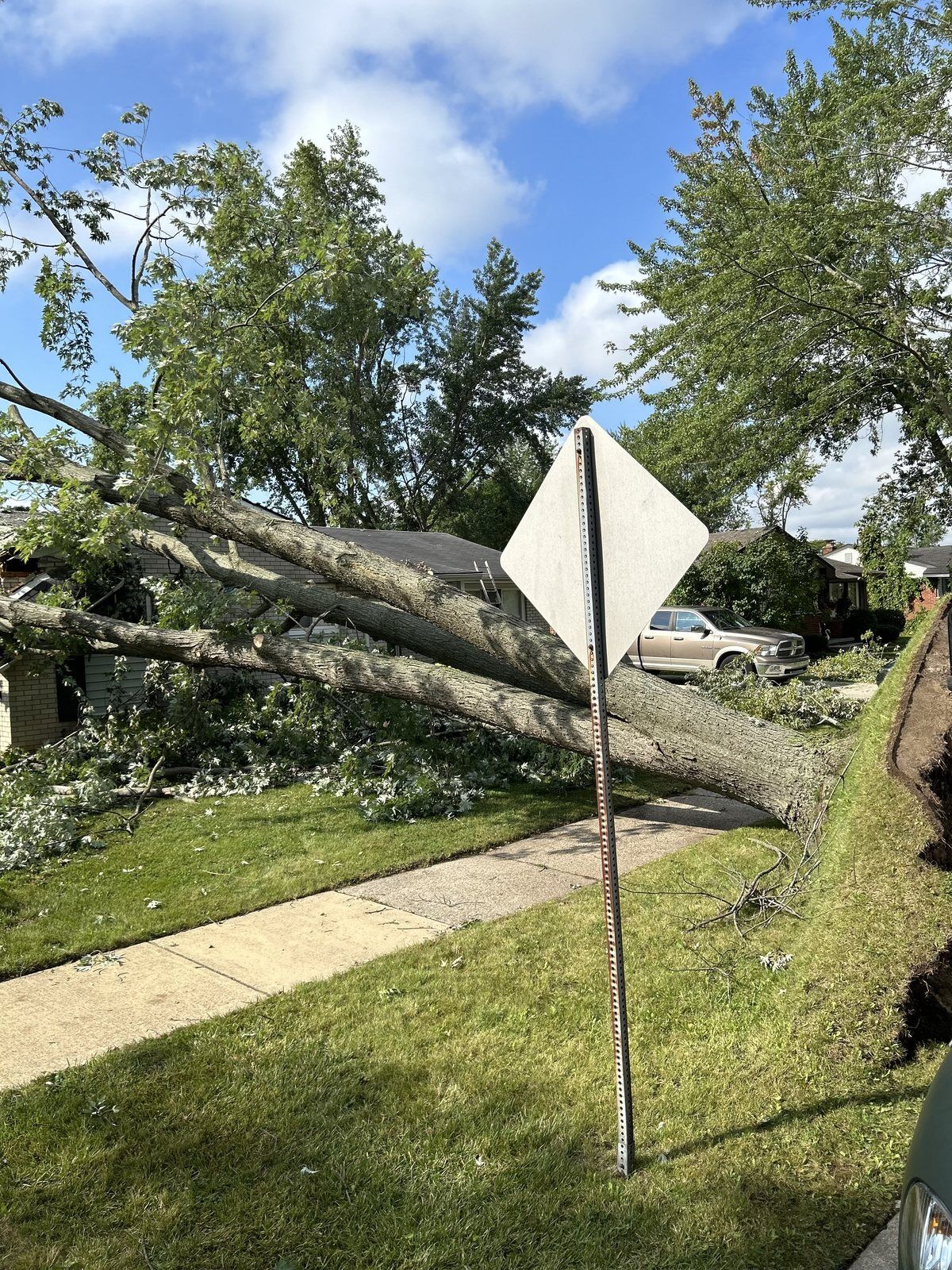
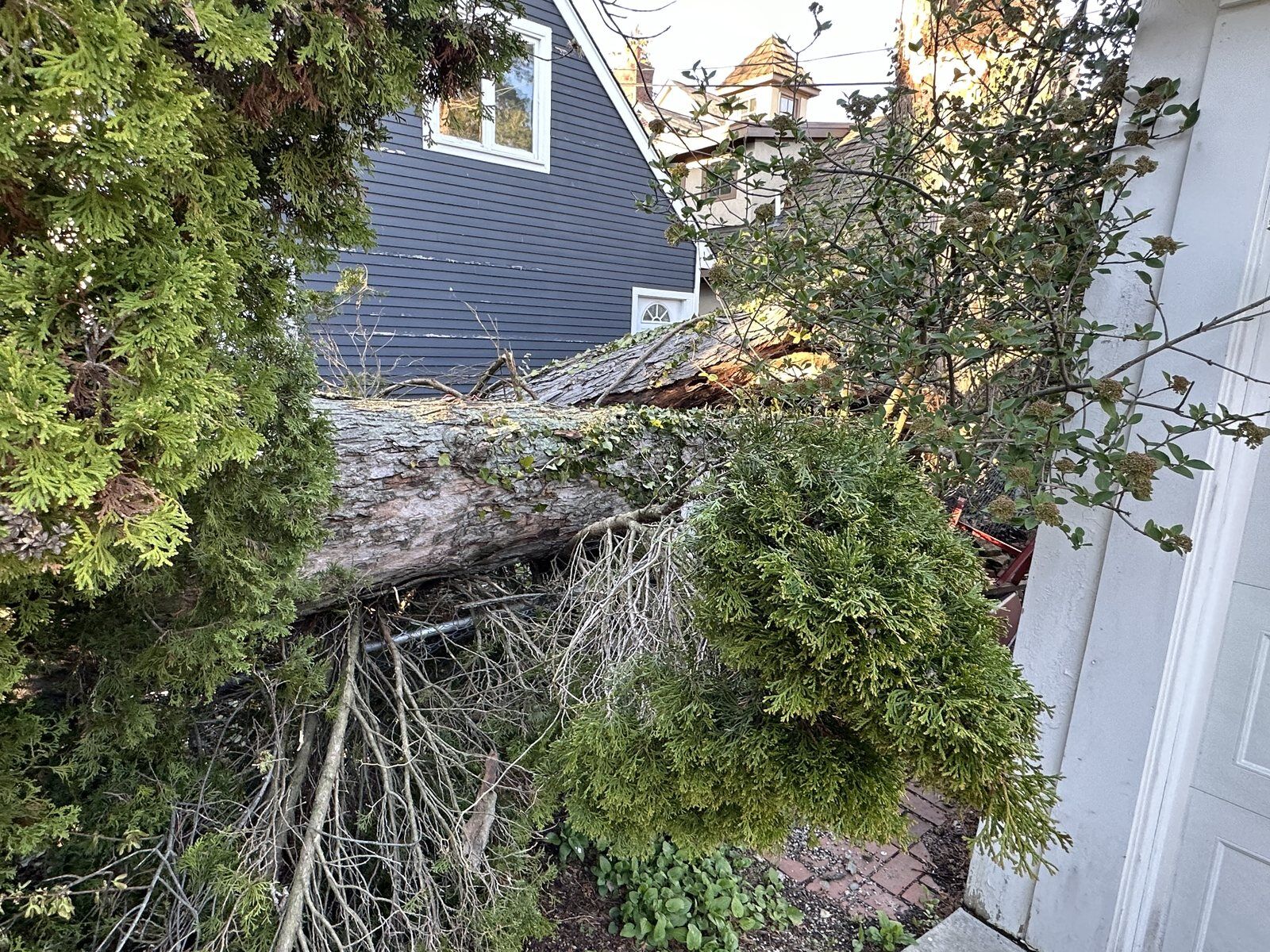
Real DriForce calls across Metro Detroit and the Blue Water Area — the moment we arrived, before the tarp went on.
Six Ways A Michigan Tree Comes Down
Most of the trees we take off houses were not healthy trees that lost a fair fight with the wind. They were telling someone for years.
- Straight-line winds after a hot afternoonMichigan’s most damaging summer events are usually not tornadoes but straight-line downbursts. Wind arrives as a wall rather than a gust, and it takes whole canopies rather than single limbs.
- Saturated ground plus moderate windA root plate that would hold in dry soil lets go after days of rain. This is why trees come down in winds that would normally be unremarkable, and why the worst nights are wet ones rather than windy ones.
- Ash that died standingEmerald ash borer left Michigan with an enormous population of dead ash that is still upright. Dead ash goes brittle and fails without warning, and it fails explosively rather than bending.
- Co-dominant trunks with included barkA tree forking into two equal stems at a narrow angle has bark trapped in the union rather than wood. It is a split waiting for a load, and it usually takes half the tree with it.
- Silver maple and Bradford pear over a roofFast-growing, weak-wooded species planted close to houses decades ago are now big enough to reach the roof and brittle enough to shed large limbs in ordinary storms.
- Roots cut for a driveway or an additionTrenching through a root plate for hardscape or an addition removes anchorage on one side. The tree looks fine for years, then falls in the one direction nobody expected — usually toward the work.
Everything Else Worth Knowing About Trees And Your Property
Spotting A Hazard Tree Before It Picks A Night To Fall
Almost every tree we remove from a roof had visible warning signs. The ones worth walking your property for: mushrooms or conks growing at the base or on the trunk, which indicate internal decay that is already well advanced by the time it fruits; a trunk cavity or a hollow sound when struck; bark falling away in sheets on a section of trunk; a lean that has recently changed, especially with soil heaving or cracked ground on the opposite side of the lean; and dead limbs in the upper canopy while the lower tree still leafs out.
Dead ash deserves its own mention in Michigan. Emerald ash borer killed ash across the state and a great many of those trees are still standing. Dead ash does not decline gracefully — it goes brittle, sheds large limbs without warning, and becomes genuinely dangerous to climb, which is why removal gets more expensive and more difficult the longer it stands.
A tree removed on a Tuesday afternoon is planned work with a written quote. The same tree removed at 2am in the rain, off a roof, is an insurance claim with a deductible and a repair.
What Happens In The First Hour, And Why The Order Is Fixed
The instinct is to get the tree off. The correct move is to close the hole first. Once a roof is open, water does not stay where the tree hit it — it runs down rafters, soaks the insulation, saturates the ceiling below, and finds wall cavities on the floor beneath that. The difference between a roof repair and a three-room repair is usually measured in hours of rain, not in the weight of the tree.
Removal itself is rigging work rather than cutting work. A trunk resting on a roof is under tension and compression in ways that are not visible from the ground, and the structure under it has already lost capacity. Taking it off in controlled sections keeps the shock load off a weakened frame; cutting through in one pass can drop the rest of the tree through the ceiling.
On downed power lines there is no judgement call to make. Treat every line as energized, keep everyone at least 30 feet away including from anything the line is touching, and let the utility confirm it is dead. A tree in contact with a live conductor can energize the ground around it.
Drying What The Opening Let In
Water that comes through a roof is not clean water by the time it reaches your ceiling. It has passed through shingles, decking, insulation and whatever else was in the attic, and it carries all of it. Saturated fiberglass and cellulose insulation does not dry usefully in place — it holds water against the structure and has to come out.
On mold: the widely repeated “mold grows in 24 to 48 hours” is a misreading of the EPA’s guidance. That window is the deadline for getting materials dry in order to prevent growth — not a measured growth rate. The practical meaning is the same either way: the clock that matters starts when the water arrives, not when someone notices it.
Wet ceiling wiring is worth naming too. The standard cable run above ceilings is rated for dry locations only, and electrical industry guidance is that soaked cable and recessed fixtures should be replaced rather than dried and reused.
Neighbors, Property Lines And Who Is Responsible
The question comes up on nearly every job where a tree crossed a property line, and the answer surprises people. In general, when a healthy tree falls from a neighbor’s yard onto your house in a storm, it is treated as an act of nature and your own policy responds to your damage — not theirs.
Where that changes is negligence. If the tree was visibly dead, decayed or hazardous, and the owner had been told about it, responsibility can shift. This is why a written, dated notification to a neighbor about a tree you are worried about is worth far more than a conversation over the fence.
We are a restoration contractor, not your attorney, and we will not pretend otherwise. What we can do is document the condition of the tree as we find it — decay, cavities, prior dieback — which is the evidence any of those conversations ends up turning on.
Tree Removal, Answered
Related Services & Nearby Communities
A tree is rarely the only thing that broke. The same certified crews handle every related loss below — and respond to every community we serve, day or night.
A tree through a roof is a storm loss with a water loss inside it. We also handle storm damage of every kind, water damage once the roof is open, roofing, and rebuild and property repairs. Crews dispatch 24/7 from our Troy office for Oakland, Macomb and Wayne counties and our Port Huron office for St. Clair County and the Blue Water Area.
Tree Down? We’re On The Way
A person will answer, and a crew will be on the way with tarps, board-up material and extraction equipment already on the truck. If the tree is on a structure or across your access, say so first — those go straight to the front of the queue.