

You just walked downstairs into standing water. Take a breath — the next hour matters more than anything else in this entire process, and you do not need to know anything about restoration to get it right. DriForce Property Restoration extracts and dries flooded basements across Metro Detroit every week, from Northville to West Bloomfield to the Blue Water Area. Here are the exact first steps our dispatchers walk every caller through, what professional cleanup involves, and how to make sure this basement never floods twice.
First Steps: The First 60 Minutes
- Do not walk into the water until the power is dealt with. A flooded basement with live outlets, extension cords, or a submerged power strip is an electrocution risk. If the breaker panel is dry and reachable without stepping in water, cut power to the basement circuits. If it is not safely reachable, stay out and say so when you call — crews handle it.
- Identify the source if you can see it — from dry ground. Burst pipe or failed water heater: shut the main water valve (usually basement-side, near the meter). Failed sump pump during a storm: nothing to shut off — note it. Water rising through the floor drain: that is a sewer backup, and the water is contaminated — keep everyone, especially kids and pets, completely away.
- Shut off the gas if appliances are submerged. A flooded water heater or furnace with a gas supply is a second hazard on top of the first.
- Photograph everything before anything moves. The waterline, the source, each affected room, damaged belongings. Your insurance claim is decided on this record — so is ours when we document the loss for your adjuster.
- Call for professional extraction — now, not tomorrow morning. Water is wicking up drywall and into framing while it sits. DriForce Property Restoration crews leave our Troy and Port Huron offices with extraction equipment already loaded and are on-site within 60 minutes, day or night.
What not to do: do not run a household shop-vac against inches of standing water, do not go back into the flooded area for belongings while water is still coming in, do not run box fans as your drying plan, and do not assume clear-looking water is clean — anything that touched the floor drain or backed up from below carries bacteria and is a genuine health hazard for your family.
What Professional Basement Cleanup Involves
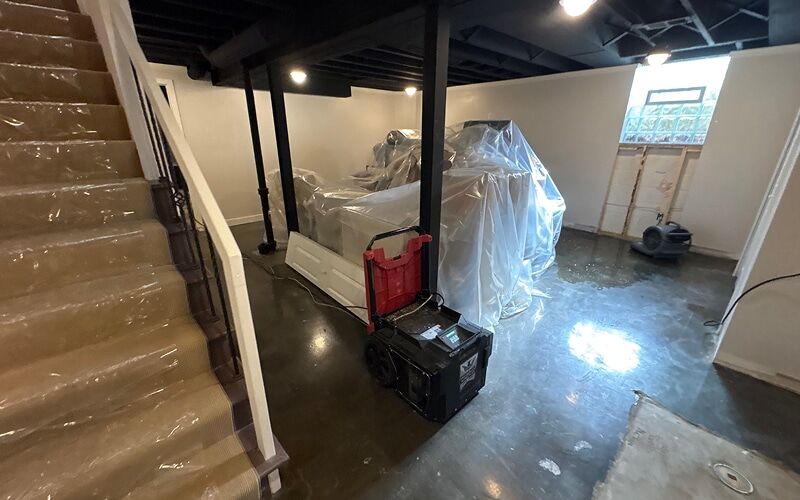
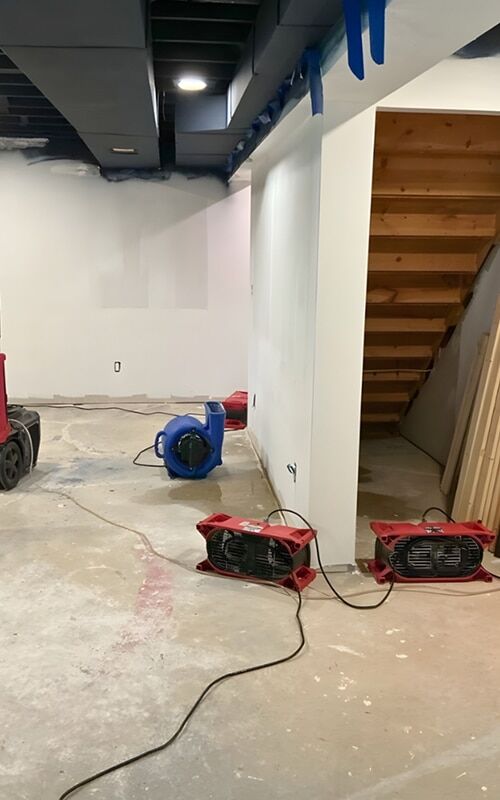
Real flood recovery is a documented sequence, not a truck full of fans. On a DriForce Property Restoration loss it runs: extraction of all standing water with commercial pumps and extractors; controlled removal of what cannot be saved (soaked carpet pad, wicked drywall cut above the waterline, waterlogged insulation); structural drying with air movers and commercial dehumidifiers placed by pattern; and daily moisture readings, logged per room, until the structure reaches documented dry standard — the readings decide when equipment leaves, not the calendar. If the water was contaminated — any sewer or drain involvement — sanitization under containment comes before drying, which is its own discipline covered in our sewage backup cleanup guide. The full process, timeline, and what to expect from your crew is on our water damage restoration page.
Why the Clock Matters: 48 Hours to Mold
Mold establishes in wet materials within roughly 24–48 hours — behind the drywall you cannot see into, under the flooring that “feels dry on top.” A basement that gets professionally extracted and verifiably dried inside that window usually needs no mold work at all. One that sat over a weekend, or got a fans-only dry-out, is how we end up doing containment and removal months later. If you are past the window or already smell must, start with our complete mold removal guide — but if you are inside it, speed is everything.
Why Michigan Basements Flood
Nearly every flooded basement we work traces to one of four causes: sump pump failure during a storm (most often a power outage taking the pump down exactly when the water table rises — our sump pump failure guide covers the warning signs and the battery-backup fix); sewer or drain backup when heavy rain surcharges the municipal system — endemic in Metro Detroit’s older combined-sewer communities; plumbing failures — burst supply lines, failed water heaters, washing-machine hoses; and ground and surface water finding foundation cracks, window wells, and poor grading. Knowing your basement’s most likely path is what makes prevention specific instead of generic — and it is the first question our crew answers on-site, because the fix for a sump problem and the fix for a grading problem are completely different projects.
What Can Be Saved — and What Has to Go
The triage question every homeowner asks first: hard, non-porous things usually survive; soaked porous things usually do not. Furniture with solid wood or metal frames, tools, glass, ceramics, and most plastics clean up well once dried quickly. Electronics that stayed above the waterline are fine; anything submerged should be evaluated before it is ever powered on. The hard goodbyes are the porous absorbers: carpet pad almost always goes (carpet itself is case-by-case with clean water), soaked particle-board furniture swells and does not come back, and mattresses or upholstered pieces that took contaminated water are not worth the health risk. Drywall wicks water upward — the standard practice is cutting it above the waterline rather than gambling on what is inside the wall. Paper — photos, documents, books — is the time-critical category: separate and air-dry the irreplaceable pieces immediately, and freeze anything valuable you cannot dry today; freezing pauses the damage until it can be treated. When the water was contaminated, the calculus shifts hard toward disposal for anything porous — and our crews document every discarded item, room by room, so your claim captures all of it.
Will Insurance Cover It?
It depends entirely on the path the water took. A burst pipe or appliance failure is the covered scenario on most standard Michigan policies. Sump overflow and sewer/drain backup are excluded unless you carry a water-backup endorsement — an inexpensive add-on we consider essential for any finished basement in this region. Rising surface water is flood, covered only by separate flood insurance. Whatever your coverage, the claim is won with documentation: source photos, the waterline, and professional moisture mapping from day one, which is exactly the package we build with every loss.
Never Twice: Hardening Your Basement
After the cleanup, spend one afternoon making the repeat impossible: add a battery-backup or water-powered sump so the pump survives the outage; have a backwater valve evaluated if your area has backup history; extend downspouts and regrade soil away from the foundation; seal window wells; test the sump quarterly with a bucket of water; and store anything valuable in the basement elevated and in sealed totes. Homeowners from Northville to West Bloomfield call us for the same four causes every year — the protected basements are the ones we never see again.
Frequently Asked Questions
Standing Water Right Now? Call DriForce Property Restoration
Call DriForce Property Restoration at (888) 838-7170 or request service online — 24/7 dispatch, on-site within 60 minutes, and we document everything for your insurance claim from the first hour.