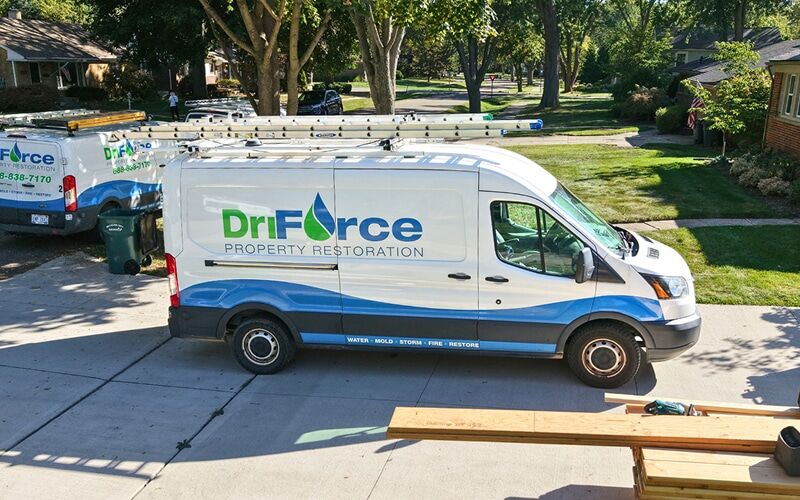
When a crew rolls equipment into your flooded house, the machines themselves tell a story. Professional restoration runs on commercial gear from a handful of manufacturers — Phoenix, Dri-Eaz, B-Air, and a few others — and knowing what each machine does helps you judge whether you hired a restoration company or a guy with a shop vac. You do not need to become an equipment expert — you need about five minutes of vocabulary, which is what this guide gives you, so the trucks in your driveway make sense and the questions you ask get real answers. DriForce Property Restoration owns its fleet outright; here is what is on our trucks, why it matters, and the questions that separate a real drying operation from a rental-counter improviser.
Air Movers: the Volume Game
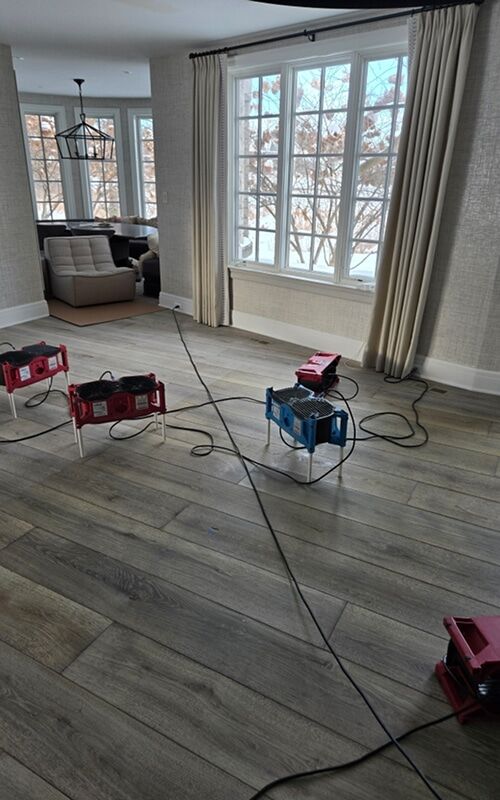
Structural drying starts with moving enormous volumes of air across wet surfaces. Commercial air movers — centrifugal and axial units — are placed by pattern, not guesswork: the count and angles come from the affected square footage and the class of water loss. A proper setup aims high-velocity air along walls and across flooring to keep evaporation running everywhere the water traveled, not just where it pooled. If a contractor sets two fans in a soaked basement and leaves, that is not drying; that is hoping.
Dehumidifiers: Where the Water Actually Goes
Air movers evaporate moisture; commercial low-grain refrigerant (LGR) dehumidifiers pull it out of the air. This is the heart of structural drying — and the machine class where pro equipment separates hardest from rentals: an LGR unit keeps extracting at humidity levels where consumer machines stall out completely. Without enough dehumidification capacity, all those air movers do is push moisture from the structure into the room air, where it settles right back onto walls and ceilings — which is how secondary damage and mold begin. Daily moisture readings, logged per room against IICRC S500 drying standards, prove the structure is actually reaching dry — which is also exactly what your insurance adjuster wants to see.
Air Scrubbers: What Runs During Mold and Sewage Work
HEPA air scrubbers — Phoenix Guardian units, Dri-Eaz HEPA 500s — filter contaminated air during mold remediation, sewage cleanup, and fire losses, often under negative pressure so contamination cannot migrate to clean rooms. A scrubber captures mold spores, soot, and airborne bacteria down to sub-micron size and exhausts filtered air, while negative-pressure containment keeps the contaminated zone sealed off from the rest of the home. Seeing scrubbers and plastic containment go up on day one is one of the clearest signs you hired a company that works to standard rather than one that treats a biohazard like an ordinary cleanup. On a sewage or mold job, a crew that skips air scrubbing and containment is not saving you money — it is spreading the contamination into rooms that were never affected, turning a contained problem into a whole-house one.
Why Owning the Fleet Beats Renting It
There is a practical reason we own our equipment instead of renting it by the day, and it directly affects your loss. A company that rents has to justify every machine and every extra day to its own margin, which quietly pressures crews to under-set equipment and pull it early. A company that owns its fleet sets the correct number of machines because the readings call for it, and leaves them until the structure hits dry standard — because the equipment is already paid for. Ownership also means a crew can respond at 2 a.m. with a full truck instead of waiting for a rental counter to open. When you ask “do you own or rent,” you are really asking whose incentives are steering the dry-out.
The Questions That Sort Pros From Pretenders
Ask any contractor three questions: Do you own your drying equipment or rent it? Do you log daily moisture readings, and can I see them? What standard do you dry to? A company working to IICRC standards answers all three without hesitation — owned fleet, yes to a readings log you can review, and the S500 water-damage standard. Vague answers, or a promise to “just leave some fans,” tell you what you need to know. There is a fourth question worth adding after a big storm, when out-of-town chasers flood Metro Detroit: where is your office? A company with a building in Troy or Port Huron will still be here when a warranty question comes up next spring; a truck with out-of-state plates will not. The equipment tells you whether they can do the work; the address tells you whether they will stand behind it. Crews dispatching to Sterling Heights and across Metro Detroit answer all three the same way, on every loss.
What the Crew Does With the Equipment Matters More Than the Brand
Here is the part the equipment badges will not tell you: the best air movers and dehumidifiers on the market do nothing if they are set wrong, too few, or pulled too early. Restoration is not a matter of dropping machines and coming back — it is a daily discipline. A real crew returns each day to take fresh moisture readings, moves and re-angles equipment as wet zones shrink, and adjusts the count to keep the whole structure trending toward dry. That daily log is the difference between a home that is genuinely dry and one that merely feels dry on the surface while moisture hides in a wall cavity, quietly seeding mold. It is also the record that protects your claim, because an adjuster approves drying against documented readings, not against a promise. So when you evaluate a restoration company, look past the logos on the equipment to the process behind it: owned fleet, correct placement, daily readings you can see, and a clear dry-standard endpoint. The machine is a tool; the standard is the service.
How Equipment Choices Show Up in Your Insurance Claim
Here is the connection most homeowners never see: the equipment on your job and the paperwork on your claim are the same story told twice. Adjusters approve drying against documented evidence — how many air movers and dehumidifiers ran, where they were placed, for how many days, and what the daily moisture readings showed. A crew running commercial LGR units with logged readings produces a claim file that approves smoothly, because every machine-day is justified by a number. A contractor who dropped two rental fans and came back Friday produces a file with holes in it — and those holes become disputes about whether the structure was actually dry, whether the mold that showed up later was preventable, and what should have been billed. This is also your protection against the opposite problem: over-billing. Industry-standard equipment rates tied to logged readings mean you and your carrier can both see that the equipment count matched the loss, no more and no less. When we walk a homeowner through what water damage repair involves, the documentation layer is half the conversation — because six months from now, the readings log is the only proof anyone has that the drying was real.
Frequently Asked Questions
Schedule Water Damage Restoration in Metro Detroit with DriForce Property Restoration
Call DriForce Property Restoration at (888) 838-7170 or request service online — crews dispatch 24/7 with a 60-minute response commitment across Metro Detroit.