

A water heater rarely fails politely. A corroded tank lets go and 40 to 80 gallons empty into your utility room in minutes – and if the supply keeps feeding the burst, it will keep flowing until someone shuts it off. DriForce Property Restoration responds to water heater floods across Metro Detroit year-round, and they spike hard in winter. Here is what to do in the first ten minutes, why the damage travels farther than people expect, and how to see the failure coming.
What Should You Do in the First 10 Minutes?
Shut Off the Water Supply
Every water heater has a cold-water shutoff valve on the inlet line above the tank. Turn it clockwise until it stops. If the valve is stuck or broken, use your home’s main shutoff – usually at the meter or where the service line enters the basement.
Kill the Power or Gas
For electric units, switch off the breaker. For gas, turn the gas control valve to OFF. A gas heater that keeps firing against an empty, flooding tank is a hazard on top of a flood.
Start Moving Water and Belongings
Water follows the floor’s slope – toward the drain if you are lucky, toward finished space if you are not. Get stored items off the floor and photograph everything before cleanup starts; that documentation carries your insurance claim.
Why Does a Water Heater Flood Travel So Far?
Because the tank refills itself. Unlike a tipped bucket, a burst tank with an open supply line flows continuously – hundreds of gallons over a few hours if nobody is home. Water finds wall cavities, wicks up drywall, and slips under flooring into rooms that look dry from above.
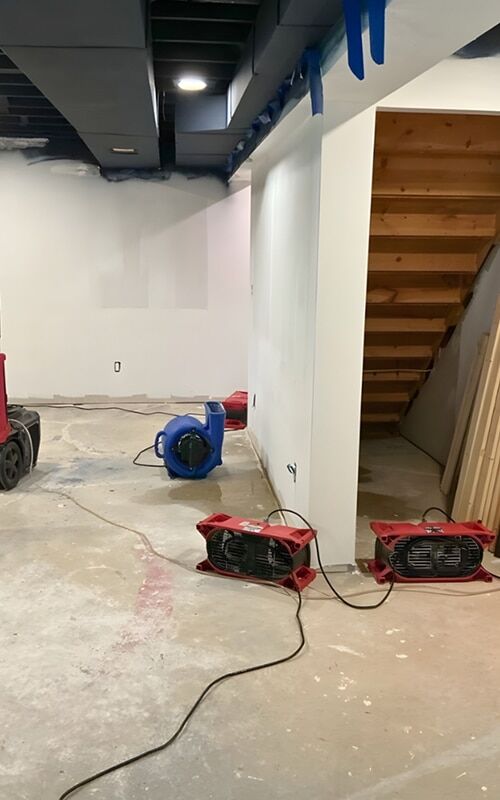
Upstairs water heaters – common in Metro Detroit condos and newer two-story homes – are the worst-case version: the water works through the subfloor, follows joists and can-light openings, and appears as ceiling stains two rooms away from the tank. By the time a stain shows, the assembly above it has been wet for a while. This is why professional water damage restoration starts with moisture mapping, not mopping: the wet you can see is rarely the whole loss. Our crews dry to verified moisture targets with commercial dehumidifiers – the same process from our guide to structural drying equipment.
Three Cheap Upgrades That Prevent the Worst Version of This
A Drain Pan That Actually Drains
A metal or plastic pan under the tank, piped to a floor drain, turns a slow tank leak into a non-event. Pans cost less than a dinner out; the finished basement they protect does not. If your pan has no drain line, it only buys you the first few gallons – better than nothing, but plumb it if you can.
A Leak Detector With Automatic Shutoff
Smart water shutoff valves monitor flow and close the supply automatically when they detect continuous unusual flow – exactly the signature of a burst tank running unattended. Standalone puck-style leak alarms under the tank are the budget version: they will not stop the water, but a phone alert at hour one instead of a discovery at day three changes the entire loss.
The 10-Year Replacement Rule
The cheapest restoration job is the one that never happens. If your tank is past 10 years, replacing it on your schedule costs a fraction of one flooded-basement deductible plus the weeks of disruption. Write the manufacture date on the tank in marker the day you read this – future you will thank present you.
Tank vs. Tankless: Does It Change the Risk?
Tankless units remove the 40-80 gallon reservoir, which removes the catastrophic-rupture scenario – but they do not remove water risk entirely: supply-line failures, heat-exchanger leaks, and frozen exterior units (a real Michigan issue) still happen. If you are replacing a failed tank anyway, tankless trades a big single risk for smaller distributed ones. Either way, the shutoff-valve upgrade above applies.
After the Water Is Off: The 48 Hours That Decide the Damage
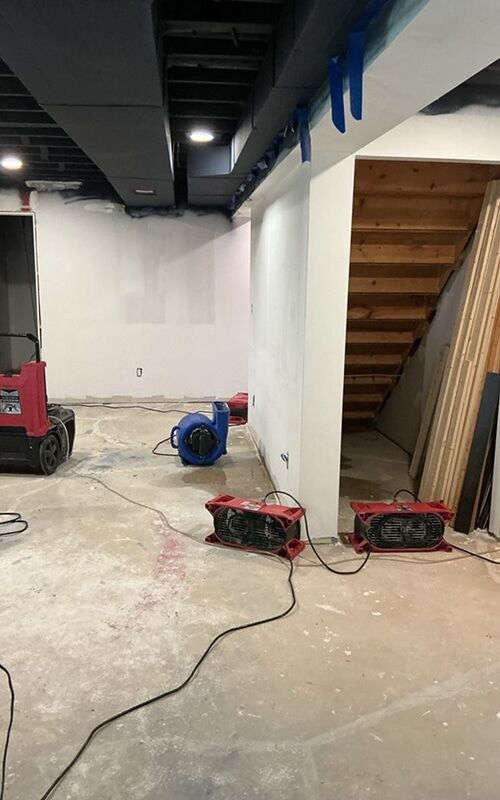
Once the tank is drained and the supply is closed, the race is against absorption. Forty-plus gallons released at floor level wicks up drywall from the bottom edge, soaks the sill plates behind baseboards, and follows the subfloor seams into rooms that look dry — and because water heaters so often live next to finished spaces, the hidden spread routinely doubles the visible footprint. Professional mitigation in this window means extraction, moisture mapping with meters and thermal imaging to find every wet cavity, baseboard removal so wall bottoms can actually dry, and commercial dehumidification running until daily readings hit dry standard — typically three to five days. The 24-72-hour mold clock applies here exactly as it does in a flood: material that stays wet past that window starts growing problems that cost far more than the drying would have. If the heater sat on an upper floor, ceiling cavities below need the same attention; water finds light fixtures and can sit on drywall for days. Our crews handle this sequence from Troy across Metro Detroit within the hour, and the moisture logs we keep become the backbone of your insurance file.
Does Insurance Cover a Burst Water Heater?
Usually yes – a sudden tank failure is a classic covered water event, and the resulting damage to floors, walls, and belongings is typically claimable. Two caveats: the water heater itself is generally NOT covered (that is a maintenance item), and a slow, long-term leak you ignored can be treated as neglect rather than a sudden loss. Fast response and day-one documentation keep the claim on the right side of that line – it is the same causation rule we explain in our sewage backup guide.
The 6-Item Claim Documentation Checklist
Before cleanup erases the evidence, capture: (1) the tank’s data plate and manufacture date, (2) the failure point – the split seam, corroded fitting, or ruptured relief line, (3) the water’s furthest reach in every direction, marked with photos, (4) serial numbers and close-ups of damaged belongings, (5) the shutoff time – when the water actually stopped, and (6) moisture readings from day one, which is where a professional crew earns its keep. Losses documented this way settle faster and fight less.
What to Save for the Adjuster Before Anything Gets Discarded
Keep the failed heater — or at minimum its data plate, serial number, and clear photos of the rupture point — because age and failure mode drive how carriers handle these claims, and a subrogation claim against a manufacturer needs the physical evidence. Photograph the water line on walls in every affected room before drying equipment goes in, and keep receipts for anything you buy in the first response, from a wet vac rental to towels. Ten minutes of documentation here routinely protects thousands in payout.
Can You See a Water Heater Failure Coming?
Usually. Tanks typically last 8 to 12 years – check the manufacture date on the serial-number sticker. Warning signs: rust-colored hot water, rumbling or popping sounds (sediment buildup), moisture or rust streaks at the tank base, and a temperature-pressure relief valve that drips. Any of those plus a tank near the 10-year mark is your cue to replace on your schedule instead of the tank’s. Homes in Novi and across Metro Detroit lose more finished basements to 12-year-old tanks than to storms.
Frequently Asked Questions
Schedule Water Damage Restoration in Metro Detroit with DriForce Property Restoration
If your water heater just let go, shut off the water and call DriForce Property Restoration at (888) 838-7170 or request emergency service online – crews dispatch 24/7 with a 60-minute response commitment.