
A supply line lets go in unit 2B, and by morning three units and a hallway are wet. Now the landlord, two tenants, and three insurance policies are pointing at each other. DriForce Property Restoration works these losses across Metro Detroit for property managers and owners, and the responsibility rules are more predictable than the finger-pointing suggests — if you know how Michigan law and the three overlapping policies fit together. Here is the whole map: who owes what, who calls whom, and the first-day moves that keep a two-unit problem from becoming a building-wide one.
What Does Michigan Law Require of Landlords?
Michigan’s landlord-tenant law (MCL 554.139) requires landlords to keep premises fit for their intended use and in reasonable repair. In water terms: the building’s systems — roofs, supply lines, drains, appliances the landlord provides — are the landlord’s responsibility to maintain, and the structure itself is the landlord’s to repair after a loss. The landlord’s property policy covers the building; it does not cover the tenant’s belongings, and it does not automatically make the landlord liable for a tenant’s damaged property unless the landlord’s negligence caused the loss. That distinction — damage to the building versus liability for someone’s contents — is where most apartment-flood disputes actually live. It also explains the most common surprise in these losses: a tenant whose belongings were ruined by a burst building pipe often assumes the landlord’s insurance will pay for their couch, and it usually will not — absent landlord negligence, the building policy rebuilds the building, and the tenant’s own renters policy is what covers the tenant’s things. Knowing that before the water arrives prevents the angriest conversation in property management.
What Are Tenants Responsible For?
Tenant-caused events — the overfilled tub, the hose left on a portable washer, the aquarium that failed — can make the tenant liable for resulting damage, which is exactly what the liability portion of renters insurance exists for. Tenant belongings are covered by the tenant’s own renters policy in either case. The tenant with no renters insurance and a flooded unit owns that loss personally — a sentence worth repeating at every lease signing. For a policy that often costs less per month than a streaming subscription, renters insurance is the single most lopsided value in this entire equation — it covers the tenant’s belongings, provides the liability protection that responds if they cause a neighbor’s loss, and helps with temporary housing if the unit becomes uninhabitable. The tenants who suffer most after an apartment flood are almost always the ones who went without it.
Who Calls the Restoration Company?
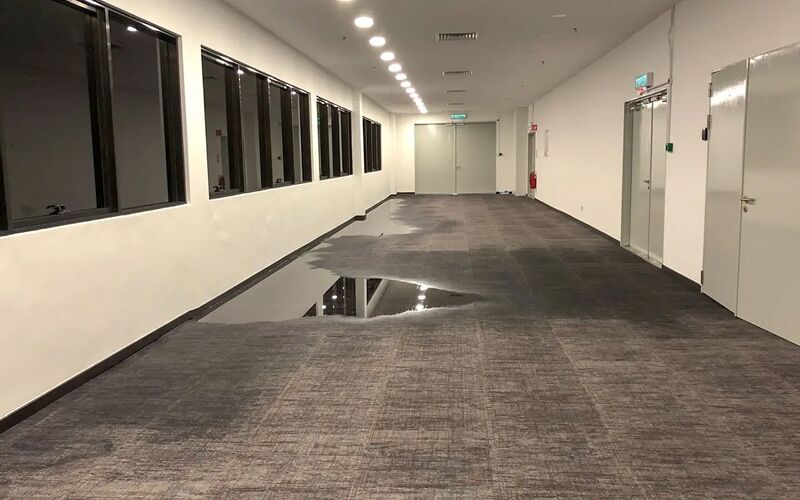
The building owner or manager should — immediately, and for the whole affected area, not unit by unit. Water travels through assemblies: drying only the unit where the pipe burst while moisture sits in the walls of the unit below is how buildings grow mold problems and secondary claims months later. A single coordinated response also keeps the documentation clean, so each insurer sees one consistent record of where the water started and how far it traveled. Our crews handle multi-unit commercial losses as one documented project, with per-unit reports each insurer can use. Handling it as one job also means one point of contact for the manager instead of several contractors tripping over each other, and one consistent timeline for getting residents back into their homes.
When Tenants Can’t Stay: Loss of Use
A serious apartment flood often means residents cannot live in the unit while it dries and rebuilds, and that raises a question landlords field within hours: who pays for a hotel? A tenant’s renters policy commonly includes “loss of use” or additional-living-expense coverage that helps with temporary housing when a covered peril makes the unit uninhabitable — another reason the uninsured tenant is so exposed. The landlord is generally responsible for restoring habitability promptly, but is not automatically the tenant’s hotel fund unless a lease term or negligence says otherwise. Setting this expectation in the lease, and encouraging renters coverage, prevents the worst of the conflict before it starts.
The First-Hour Checklist for Property Managers
Kill the water source, kill power to affected areas if safely possible, notify affected tenants in writing, photograph everything, and get professional drying started — the same day. Response speed determines whether this is a two-unit dry-out or a building-wide reconstruction: every hour the water sits, it wicks further into shared walls, ceilings, and the units below. Document the source and the spread as you go, because that record is what assigns cost to the correct policy later. Crews serving Southfield and all of Metro Detroit dispatch 24/7, and our commercial water damage guide covers the longer version of this checklist.
Condos and HOAs Play by a Different Rulebook
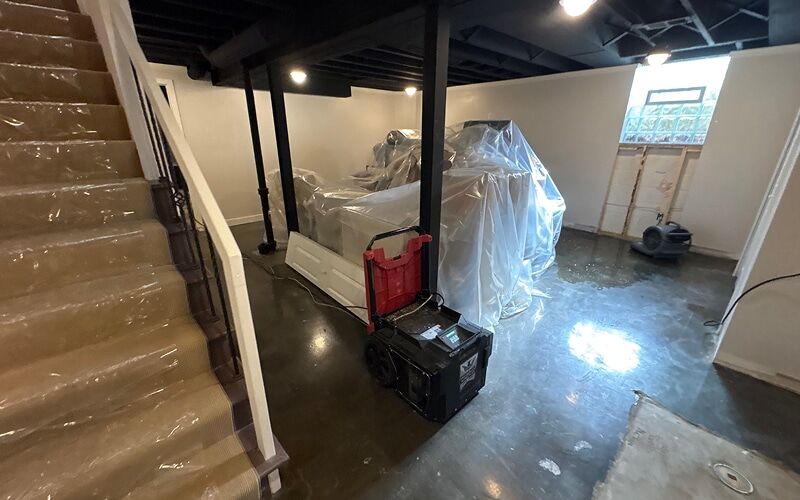
Multi-unit does not always mean apartments, and condominiums add a layer worth understanding before water ever moves. In a Michigan condo, the association’s master policy and governing documents draw a line between the “common elements” the HOA maintains and insures and the “limited common” or unit-owner elements the individual owner is responsible for — and that line is not the same in every association. A supply line inside a shared wall may be the association’s problem; the flooring and cabinets it ruins may be the unit owner’s, covered by their individual HO-6 condo policy. When a loss crosses several units, you can end up coordinating a master policy, multiple HO-6 policies, and possibly a tenant’s renters policy all at once. The practical answer is the same as with apartments: respond fast, dry the whole affected area as one project, and document per unit so each policy can be matched to its portion of the loss. We regularly build that documentation for associations and property managers so the coverage conversation starts from facts instead of finger-pointing.
The First 24 Hours: A Unit-by-Unit Walkthrough
Here is what the response actually looks like when it goes right. Hour one: the source unit’s water is shut, power to affected areas is killed where needed, and extraction starts in the source unit while moisture mapping begins in every adjacent unit — beside, below, and diagonal, because water travels through shared assemblies in all three directions. Hours two through six: standing water is out, affected tenants have written notice, and drying equipment is placed by pattern in every unit the mapping flagged — including the ones whose walls “look fine” but read wet. By hour twenty-four: every affected unit has a documented baseline reading, the property manager has a scope listing exactly which units and materials are involved, and each insurer in the chain has the documentation that matches its policy to its portion. Compare that to the alternative — drying only the source unit and waiting to see — and the difference six weeks later is two rebuilt closets versus a mold problem spanning three floors. The mechanics of professional water damage repair are the same as a single-family loss; the discipline of running them across every affected unit at once is what separates a building that recovers in days from one that litigates for months.
Frequently Asked Questions
Schedule Commercial Water Damage Restoration in Metro Detroit with DriForce Property Restoration
Call DriForce Property Restoration at (888) 838-7170 or request service online — crews dispatch 24/7 with a 60-minute response commitment across Metro Detroit.